

It’s 2:14 AM and a water heater just let go in a finished basement across town. The homeowner is standing in an inch of water, calling plumbers in the order Google lists them. Your AI receptionist answers on the first ring, takes the address, and tags it an emergency. Good. Now what? If the answer is “it sits in a queue until 7 AM,” you did the hard part and still lost the job. Capturing the call is not the same as dispatching it. The on-call rotation is the system that decides who gets that call, how fast, what they’re paid to be available, and what happens when the first tech doesn’t pick up, so a truck is moving before she dials the next shop.
In this guide
- Why capturing the call isn’t dispatching it
- What a 2 AM call is actually worth
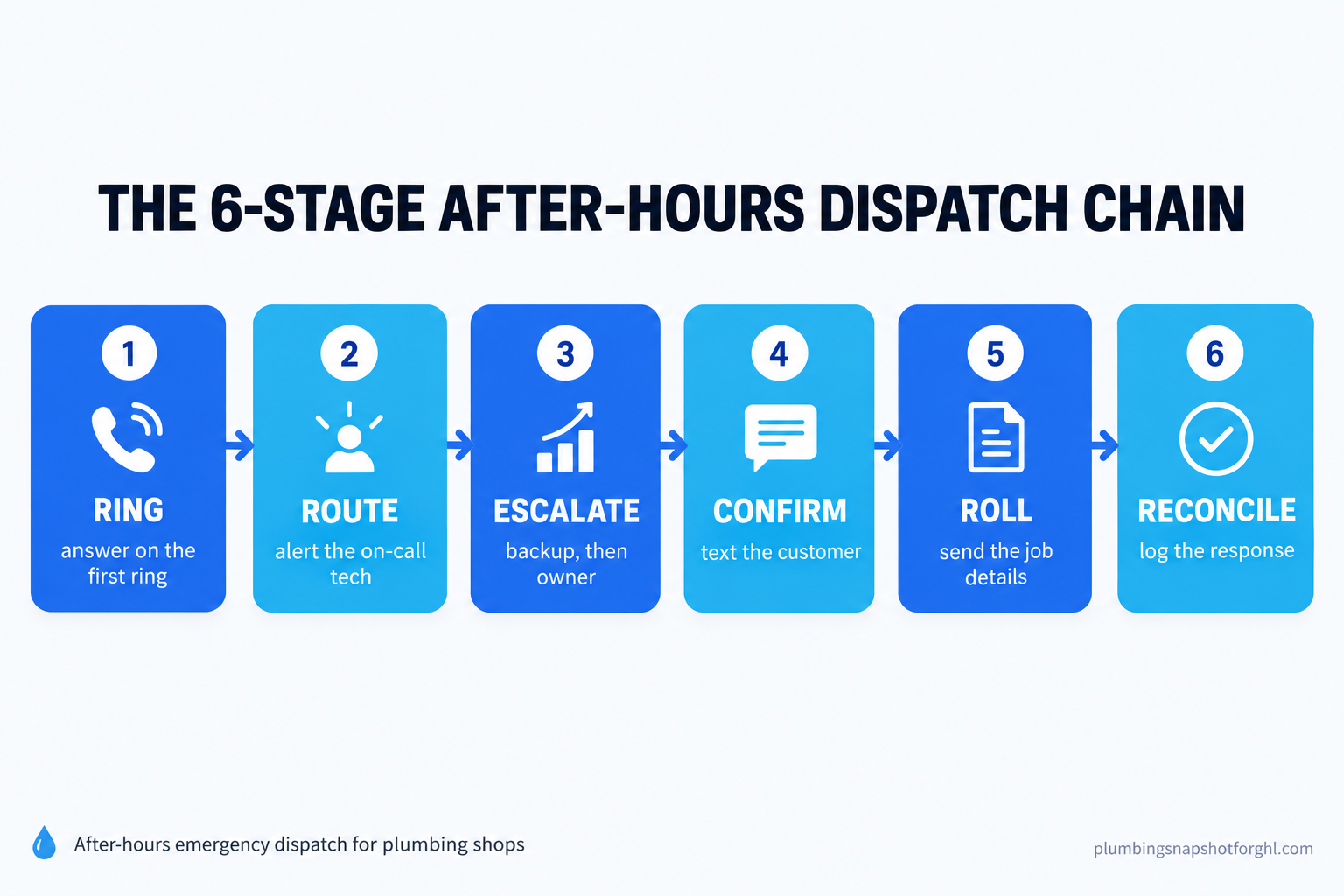
- The 6-stage after-hours dispatch chain
- Stage 1. Ring: capture on the first attempt
- Stage 2. Route: build the rotation
- Stage 3. Escalate: the ladder when nobody answers
- Stage 4. Confirm: the “tech is on the way” loop
- Stage 5. Roll: what the tech needs first
- Stage 6. Reconcile: track it and close the loop
- Pay it right: on-call pay and the FLSA line
- Solo, 5-truck, and 15-truck
- Steal this: the on-call scripts
- Objections, answered straight
- Frequently asked questions
Why capturing the call isn’t dispatching it
Most shops that lose money after hours think they have a phone problem. They buy an answering service or wire up an after-hours AI receptionist, the call gets answered, and they assume the leak is plugged. It isn’t. Answering is capture. Getting a qualified tech committed and moving is dispatch, and dispatch is where the job is won or lost.
Here’s the gap. Your service takes the message, then emails it to an inbox or texts a number nobody is watching, or the “on-call” plumber is asleep with the ringer off because there was never a real rotation. The homeowner waits ten minutes, hears nothing, and calls the next shop, which had a tech on a paid on-call shift who called her back in four minutes and booked the job. You never knew it existed. You can capture every call and still convert none if there’s no rotation, no escalation, and no accountability behind the phone. The good news: dispatch is a system, not a personality. Build it once and it runs whether you’re awake or not.
What a 2 AM call is actually worth
After-hours calls are not small calls. They’re the burst pipes, sewage backups, and no-hot-water-with-a-newborn calls. They convert high because the customer has an emergency and no patience to shop, and they carry premium tickets because the work is urgent and the hour is ugly.
Water damage and freezing are the second-largest cause of homeowners insurance losses after wind and hail: 1.6% of insured homes had such a loss each year from 2018 to 2022 (Insurance Information Institute). Behind each one is a homeowner who called a plumber in a panic, and the shop that answered and rolled a truck got the repair. Demand isn’t shrinking, either: the Bureau of Labor Statistics projects plumber employment to grow 7% from 2025 to 2035, faster than average, with about 42,000 openings a year (U.S. Bureau of Labor Statistics).
The point isn’t the dollar figure on any one job. It’s that after-hours calls are the highest-intent calls you get, and they go to whoever responds first. That’s a speed problem, and speed is a system problem.
The 6-stage after-hours dispatch chain
Every after-hours call that turns into a booked job passes through the same six stages. Miss one and the chain breaks: a captured call with no route dies in an inbox, a perfect route with no escalation dies when the tech’s phone is on silent, a great dispatch with no confirmation leaves the customer calling around while your tech drives.
Relative likelihood of qualifying a new inbound lead by response speed, indexed so responding after 24+ hours = 1. A Harvard Business Review audit of 2,241 companies found firms answering within an hour were about 7× more likely to qualify a lead than those responding an hour later (Harvard Business Review, 2011). After hours the effect is sharper, because the customer is dialing competitors while she waits.
The stages are Ring (capture), Route (assign the on-call tech), Escalate (ladder to backup, then owner), Confirm (tell the customer a tech is coming), Roll (give the tech what they need), and Reconcile (log the response). Here’s each one, and how it breaks.
Stage 1. Ring: capture on the first attempt
The chain starts with a human or competent AI picking up on the first or second ring, every time. A call that hits voicemail after hours is mostly lost: the customer hangs up and dials the next result. Whether you use a live answering service, an AI receptionist, or an in-house forwarded line, capture three things: the address, the nature of the emergency, and a callback number.
How it breaks: the service takes a message but can’t tell a burst pipe from a dripping faucet, so a true emergency gets treated like a Monday callback. Fix it with the two-question triage script below. A plumbing answering service that only takes names is capture without triage, and triage decides whether Stage 2 fires now or waits until morning.
Stage 2. Route: build the rotation
Routing means the emergency instantly reaches a specific, named tech who agreed to be reachable tonight. Not “the team.” A person. This is the rotation, and it’s the heart of the system.
A real rotation is written a week ahead, so each tech knows which nights they’re on. One primary is on call per night or per week depending on your size, and there is always a named backup. Publish it where everyone sees it, rotate fairly (including yourself if you still turn wrenches), and rotate holidays deliberately, because that’s where resentment builds fastest. The trigger has to be automatic: when Stage 1 tags a call an emergency, the system alerts tonight’s on-call tech by call and text with the address and problem, no dispatcher required at 2 AM. This is where a two-way SMS and dispatch setup earns its keep.
How it breaks: “everybody’s kind of on call,” which means nobody is, and the call lands in a group text where each tech assumes another will grab it. Assign one primary, every night, by name, and make the alert person-specific and automatic. A schedule on paper with alerts hitting a shared inbox is a schedule, not a dispatch system.
Stage 3. Escalate: the ladder when nobody answers
Techs are human. The on-call plumber is in the shower, driving, or dead asleep through a buzz. Without an escalation ladder, one miss is a lost job. With one, the call rolls to the next rung in ninety seconds and you never feel it.
Build a simple ladder with time limits:
- Primary on-call tech is alerted (call + text). No acknowledgment in about 3 minutes, escalate.
- Backup tech is alerted the same way. No acknowledgment in another 3 minutes, escalate.
- Owner or lead is alerted as the last rung and always answers.
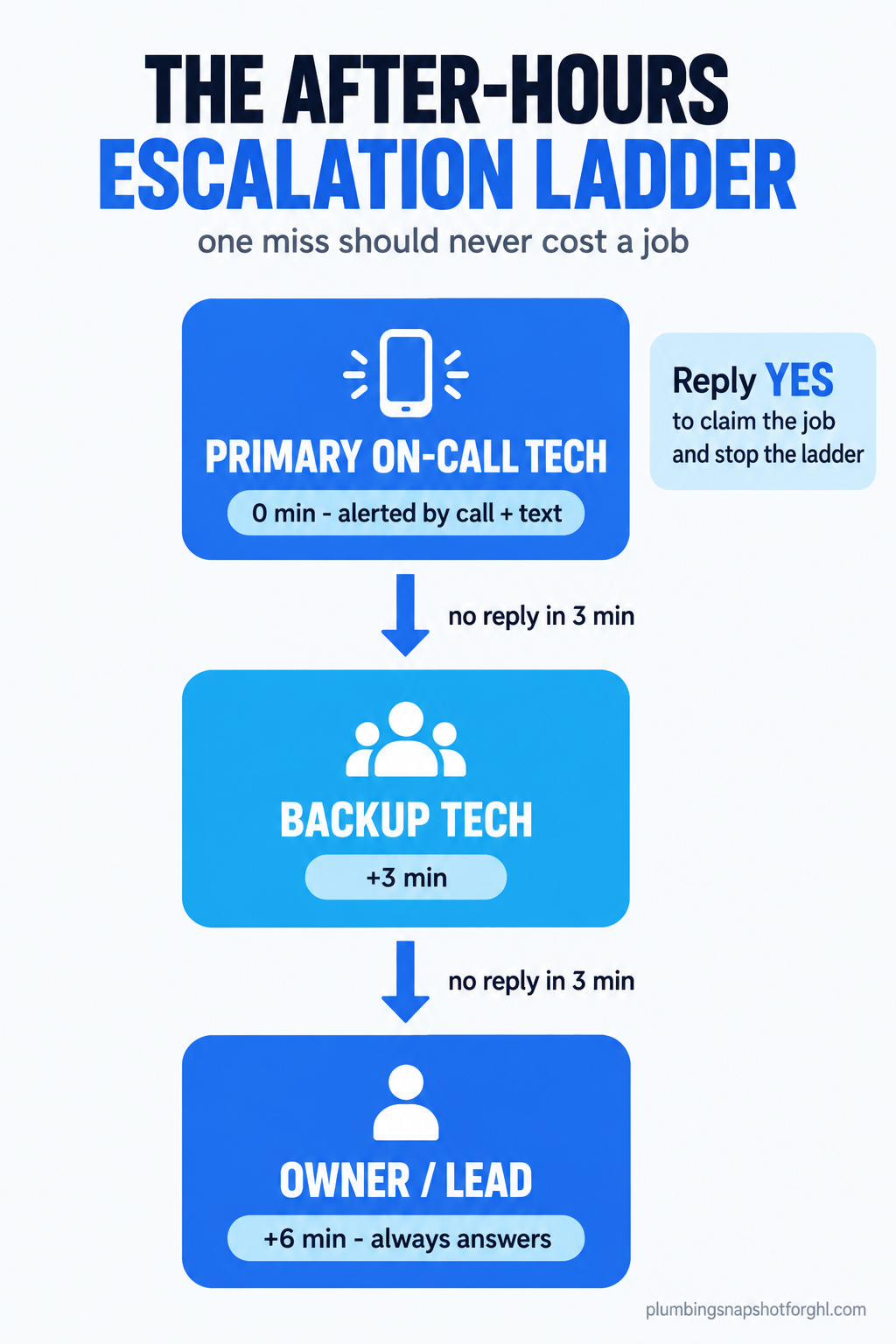
“Acknowledgment” is one tap: the tech replies YES to claim the job, which stops the ladder. No reply, the clock runs and the next person gets it. The whole ladder should resolve inside ten minutes, faster than the customer will wait.
How it breaks: no time limits, so escalation is really “hope the first guy wakes up,” and no floor, so if the backup misses too it dead-ends. Put a hard timer on each rung, and make the last rung someone who always answers, usually you.
Stage 4. Confirm: the “tech is on the way” loop
The moment a tech claims the job, the customer gets a text: someone is coming, roughly when, and who. This stops her from calling other shops, because she now believes help is arriving, and it stops her calling you every ten minutes for a status. It’s a short, automatic message triggered by the YES in Stage 3. Name the tech, give an honest ETA, and give a number to reply to. Keep it calm, because at 2 AM a scared customer reads tone.
How it breaks: silence between “we’ll send someone” and the truck showing up forty minutes later. In that gap she calls three more shops and books whoever picks up, and now two trucks roll to one job. Close it with an automatic confirmation the instant the tech claims it, plus a “10 minutes out” text when he’s close. Compliance note: automated SMS is regulated. You need consent and the right registration before sending at scale, which we cover in the plumbing marketing compliance guide. A TCPA problem is more expensive than any single after-hours job.
Stage 5. Roll: what the tech needs first
A claimed job with no information is a slow job. The on-call tech shouldn’t have to call back for the address or show up not knowing it’s a gas water heater in a crawlspace. Everything captured in Stage 1 should land on his phone with the dispatch: name, address, phone, the described problem, gate or access notes, and history if it’s an existing customer. That’s the difference between a tech rolling in five minutes and one who spends fifteen playing phone tag to reconstruct what your service already knew. If capture and dispatch live in the same system the handoff is automatic; if they live in two disconnected tools someone re-keys it by hand, and after hours that someone doesn’t exist. We broke that tax down in why disconnected tools lose jobs.
How it breaks: the tech gets a name and number but no address or detail, so his first move is a callback that wakes a customer who just fell back asleep. Push the full job record with the dispatch, access notes included.
Stage 6. Reconcile: track it and close the loop
The morning after, someone should see what happened overnight: how many emergency calls came in, who claimed each, how long from ring to acknowledgment, and whether every one got a truck. You can’t improve a response time you don’t measure, or spot the tech who keeps missing his nights if nothing is logged. Reconcile also closes the customer loop: the 2 AM job should flow into normal follow-up, an invoice, a same-day review request, and a nudge toward a maintenance plan, so the emergency customer becomes a repeat customer. An emergency call is the most expensive way to acquire a customer and the best time to keep one, because you just saved their basement.
How it breaks: no log, so “how are we doing after hours” is a vibe instead of a number, and the job never enters your daytime pipeline, so you skip the review and membership offer on your most grateful customer of the week. Track ring-to-acknowledgment on every emergency and route completed jobs straight into follow-up.
Pay it right: on-call pay and the FLSA line
Here’s where owners get burned. You can’t just tell a non-exempt tech “keep your phone on” all weekend for free and assume it’s fine. Whether on-call time has to be paid turns on how much the arrangement restricts the tech’s freedom: the line federal wage law draws between being “engaged to wait” (working, must be paid) and “waiting to be engaged” (free to use the time, generally not paid) (29 CFR 785.17).
In plain terms: if your tech can be home, sleep, and run errands, and just needs to answer within a reasonable window, that idle on-call time usually isn’t compensable. If you require him to stay at the shop, respond in an unreasonably short window, or field so many calls he can’t use his own time, the rule treats that as hours worked. And time he spends taking a call, driving, and doing the job is paid, which for a non-exempt tech counts toward overtime: hours over 40 in a week are paid at not less than time and a half (U.S. Department of Labor).
Most shops handle this cleanly with a flat on-call stipend for carrying the phone, plus normal and overtime wages for actual call-outs. That’s fair, simple, and keeps you out of a wage claim. Check your state too, because some are stricter than the federal floor. This isn’t legal advice; when in doubt, run your setup past an employment attorney once, then reuse it.
How it breaks: treating on-call as free and hoping nobody complains. One disgruntled tech and a labor complaint later, “free” gets expensive. Write the policy down, put it in the handbook, and pay the stipend on the same schedule every time.
Solo, 5-truck, and 15-truck
The chain is the same at every size. What changes is who fills each rung and how much you automate.
After-hours dispatch by shop size
| Plan | Solo operator | 5-truck shop recommended | 15-truck shop |
|---|---|---|---|
| Price | You are the rotation | Weekly rotation | Nightly + dispatch logic |
| Feature 1 | Capture: AI or answering service so you can sleep | Capture: AI or service answers and tags emergencies | Capture: AI handles volume, overflow to a service, all tagged |
| Feature 2 | Route: everything comes to you, triaged so only true emergencies wake you | Route: one primary tech per week, alerted automatically by name | Route: nightly on-call by zone or skill, auto-assigned |
| Feature 3 | Escalate: one trusted sub for nights you truly can't go | Escalate: primary, backup, owner, with 3-minute timers | Escalate: multi-rung ladder ending with the owner |
| Feature 4 | Confirm: automated on-the-way text buys time to wake and drive | Confirm: fully automated confirmation and ETA texts | Confirm: automated, plus a live dispatcher on peak freeze nights |
| Feature 5 | Pay: no on-call pay question; it's your business | Pay: flat weekly stipend plus OT for call-outs, in writing | Pay: structured on-call bands, hours tracked for OT compliance |
| Feature 6 | Biggest risk: burnout. Triage hard so routine calls wait for morning | Biggest risk: fairness. Rotate holidays and hard weekends deliberately | Biggest risk: blind spots. Reconcile response times weekly, coach laggards |
A solo operator’s whole system is “answer, triage, and don’t burn out.” A 5-truck shop needs the written weekly rotation and the escalation ladder, and that’s where most of the value shows up. A 15-truck shop runs a mini dispatch operation and lives or dies on the Stage 6 reconcile, because at that size a slow rung hides in the volume. The bigger you get, the more the chain has to be automated, because you can’t personally catch the misses anymore.
Steal this: the on-call scripts
Copy these, change the names, and drop them into your capture and dispatch flow. This is the language that keeps the chain moving.
1) After-hours triage (Stage 1, whoever answers):
"Thanks for calling [Shop]. So I get the right person moving: is this an
active emergency right now, water you can't stop, no heat, or sewage
backing up, or a repair we can schedule for the morning?"

 EMERGENCY: "Okay, I'm dispatching our on-call plumber now. What's the
   service address, and is there a gate or code? I'll text a confirmation
   in the next few minutes."
 SCHEDULE: "Got it. The office will call you first thing at [time] to
   lock in a slot."
2) On-call dispatch alert (Stage 2, to the on-call tech):
EMERGENCY, [Shop]
[Time] . [Nature: e.g. burst pipe, basement]
[Customer name] . [Phone]
[Address] . [Gate/access notes]
Reply YES to claim. No reply in 3 min routes to backup.
3) Escalation to backup (Stage 3):
UNCLAIMED EMERGENCY, you're up.
[Address] . [Nature]
Primary didn't respond. Reply YES to claim now, or this goes to [Owner].
4) Customer confirmation (Stage 4, auto-fires when tech taps YES):
Hi [Name], this is [Shop]. [Tech] is on the way to [address] now and should
arrive in about [ETA]. He'll call if anything changes. Reply here with gate
codes or anything he should know. Hang tight, help is coming.
5) “Almost there” (Stage 4, second touch):
[Name], [Tech] is about 10 minutes out. If you can, please clear the area
around the [water heater / main shutoff]. See you soon.
Keep every automated text opt-out compliant and send only to customers who’ve consented; the compliance guide has the consent language and registration steps.
Objections, answered straight
“I’m solo. I don’t need a rotation, I answer my own phone.” You need the smallest version, not none: triage (so routine calls don’t wake you), the automated confirmation text (so you can wake up and drive without the customer bailing), and one trusted backup for nights you genuinely can’t go. “I answer my own phone” works right up until the night it doesn’t, and that’s the night you lose a repipe.
“Won’t on-call stipends eat the profit from the calls?” Do the math on one job. A single after-hours water heater or burst-pipe repair usually clears more than a week of modest stipends. The stipend isn’t a cost, it’s what makes reliable coverage possible, and coverage is what books the emergency instead of the shop across town. Unpaid, resented on-call quietly costs more: techs who “didn’t hear the phone,” turnover, and the wage-claim risk above.
“My answering service already handles this.” It handles capture, and maybe triage. It does not route to a named on-call tech, escalate when he misses, send the confirmation text, or reconcile. Ask your service one question: when a burst-pipe call comes in at 2 AM, what happens next, and how fast does a specific tech know? If the answer is “we email your office,” you have capture and no dispatch.
“Do I need special software?” No, but you need the pieces connected. You can run a rotation on a shared calendar and escalation off a phone tree, but it gets fragile fast, because the automatic parts (fire the alert, run the timers, send the confirmation) are exactly what a human at 2 AM won’t do reliably. That’s the case for wiring it into one flow, which is what our dispatch-focused setup does inside GoHighLevel.
“What if the on-call tech just won’t answer?” That’s what the ladder and reconcile are for. The ladder means one miss doesn’t cost a job, because it rolls to backup in three minutes. The reconcile means a chronic misser shows up in the log, and you coach or re-slot him. A rotation without accountability decays into “whoever feels like it,” so measure it.
Frequently asked questions
What is an on-call rotation for a plumbing company?
It's a written schedule that assigns one named tech, plus a backup, to handle emergency calls during off hours. It defines who is reachable, how they get alerted, what happens if they miss, and what they're paid for being available, so after-hours calls reach a specific person fast instead of dying in an inbox.
Do I have to pay plumbers for being on call?
It depends on how restricted they are. Federal wage rules distinguish being 'engaged to wait' (so restricted it counts as paid work) from 'waiting to be engaged' (free to use the time, generally unpaid). If a tech can be home and just answer within a reasonable window, that idle on-call time usually isn't compensable, but time spent on an actual call-out is paid and counts toward overtime. Many shops pay a flat stipend plus wages for real work; check your state and, when unsure, ask an employment attorney.
How fast do I need to respond to an after-hours plumbing call?
As close to immediately as you can. Lead-response research shows contacting a new lead within about five minutes versus thirty makes you far more likely to qualify them, and after hours the customer is calling other shops while she waits. Target a tech acknowledging the dispatch within a few minutes and a confirmation text going out the moment he claims it.
What's the difference between an answering service and a dispatch system?
An answering service captures the call and takes a message. A dispatch system routes that call to a specific on-call tech, escalates automatically if he misses, texts the customer that help is coming, and gives the tech the job details before he drives. Capture is step one; dispatch is what gets a truck rolling.
How do I build an escalation ladder for after-hours calls?
Alert the primary on-call tech by call and text; no acknowledgment in about three minutes, alert the backup; if the backup misses, alert the owner, who always answers. Use one-tap acknowledgment (reply YES) to stop the ladder, and put hard time limits on each rung so the whole thing resolves inside ten minutes.
Can GoHighLevel handle plumbing emergency dispatch?
Yes. GoHighLevel can tag emergency calls, route an alert to the on-call tech based on your rotation, run escalation with timers, and fire the customer confirmation text automatically. The Plumbing Snapshot ships these flows prebuilt so you don't wire them from scratch.
Hector spent nine years dispatching for a 12-truck plumbing operation before he ever touched a CRM, and he mapped the after-hours call flow, on-call rotation, and emergency-dispatch SMS in the Plumbing Snapshot. Related reading: the 2 AM AI receptionist playbook, missed-call text-back, and the 7 emergency-call automations that pay for themselves.