
It’s 4:15pm and two of your techs just closed out a water heater swap. Same 50-gallon gas unit, same neighborhood, same drive time. One wrote it up at $1,650. The other charged $1,190. They both used their gut and how the customer looked at them in the driveway. That $460 gap is not a rounding error. Run it across 300 water heaters a year and it’s real money walking off the truck. A flat-rate price book fixes this: one price for one job, built from your real costs, presented the same way on every call, so the number stops depending on which tech knocked on the door.
In this guide
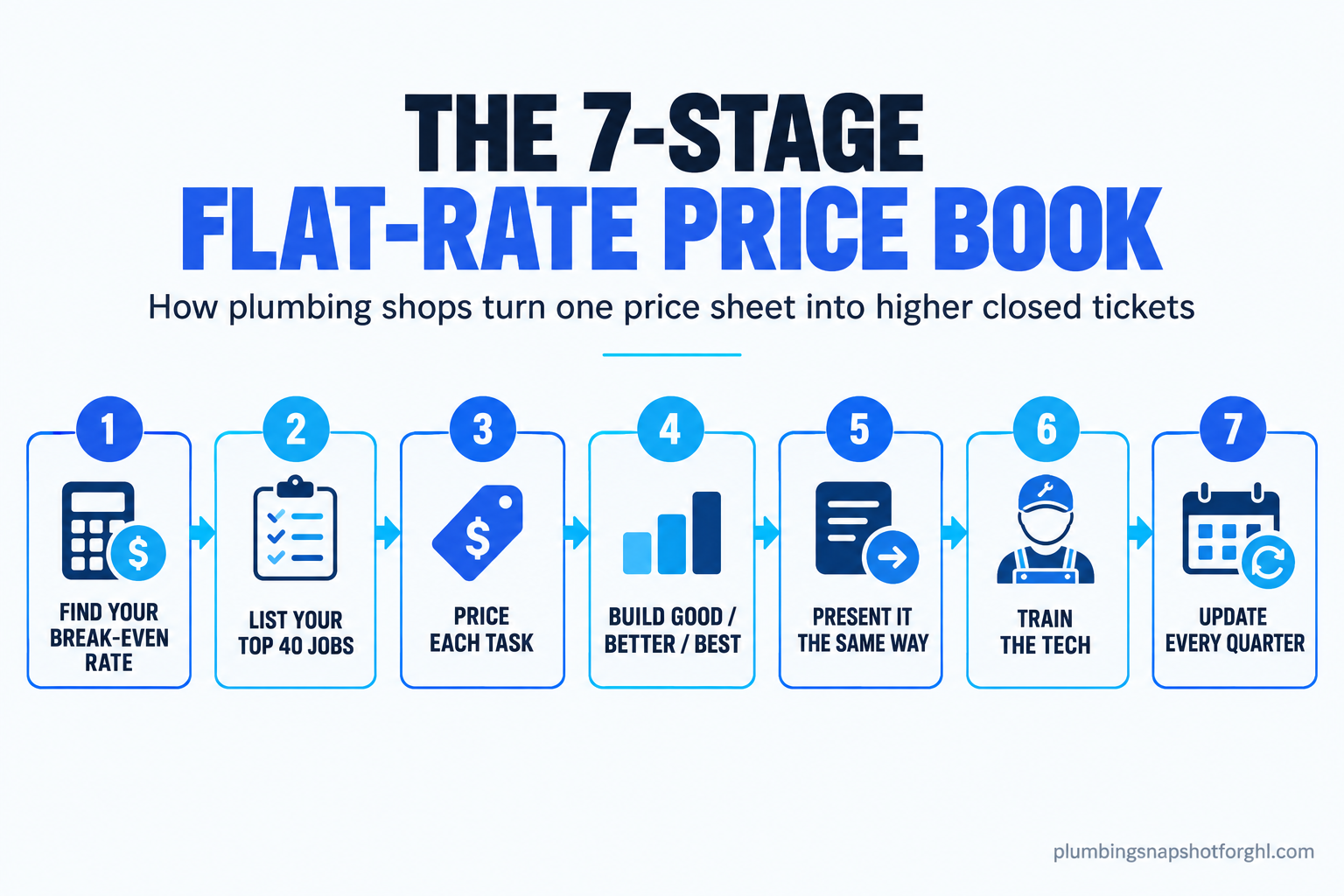
- What a flat-rate price book actually is
- Why time-and-materials quietly bleeds your shop
- Stage 1: Find your real break-even hourly rate
- Stage 2: List your top 40 jobs
- Stage 3: Price each task
- Stage 4: Build good, better, best
- Stage 5: Present it the same way every time
- Stage 6: Get the tech to actually follow it
- Stage 7: Update it every quarter
- Solo, 5-truck, and 15-truck
- Steal this: the price presentation script
- Keep it legal and transparent
- Objections, answered straight
- Frequently asked questions
What a flat-rate price book actually is
A flat-rate price book is a list of your common jobs, each with a fixed, pre-set price the customer sees before any work starts. “Replace 50-gallon gas water heater” is one line with one number. The price already has your labor, overhead, parts markup, and profit baked in.
That’s the opposite of how most small shops still price. Time-and-materials, an hourly rate plus parts, punishes your best techs, since the fast ones earn you less, and turns every invoice into a small argument. Flat rate flips it: the customer buys a result, not your hours, and a fast tech becomes a profit center instead of a discount.
The major platforms all lean this way now. ServiceTitan ships a flat-rate catalog called Pricebook Pro (ServiceTitan), Housecall Pro bundles one powered by Profit Rhino (Housecall Pro), and Workiz sells a prebuilt Price Book Pro (Workiz). Our breakdown of what plumbing software actually costs covers their price tags. But you don’t need any of them to start. You need the method below and a spreadsheet.
Why time-and-materials quietly bleeds your shop
Labor is your biggest lever and your biggest cost. The median plumber wage is $62,970 a year, about $30.27 an hour (U.S. Bureau of Labor Statistics, May 2024), and that’s before payroll tax, insurance, the truck, and the phone that rings all day. When you bill by the hour, every one of those costs has to be recovered inside a number the customer is watching tick up, so techs round down to avoid the fight. The leak never shows up as a lost job. It shows up as a booked job that earned $400 less than it should have.
The other cost is trust. A homeowner over a leaking heater calls down the list until someone gives them a number they believe. A vague “around a thousand, maybe more” loses to a confident “$1,290, done today, here’s what’s included.” And that heater is not a small ticket: water damage and freezing claims average $13,954 and hit roughly one in 60 insured homes a year (Insurance Information Institute, 2018–2022 data). Flat rate lets your tech quote that without flinching. Now let’s build the book.
Stage 1: Find your real break-even hourly rate
Every price sits on top of one number: what an hour of billable work costs you to deliver. Get this wrong and every line is wrong. The formula (ServiceTitan):
Break-even hourly rate = (total payroll + total overhead) ÷ total billable hours.
Payroll is not just the wage. Add payroll tax, workers’ comp, and benefits: a tech you pay $30 an hour usually costs closer to $42 loaded. Overhead is everything that keeps the doors open whether or not a truck rolls: rent, software, insurance, admin pay, advertising, fuel, and truck payments. Add it up for the year.
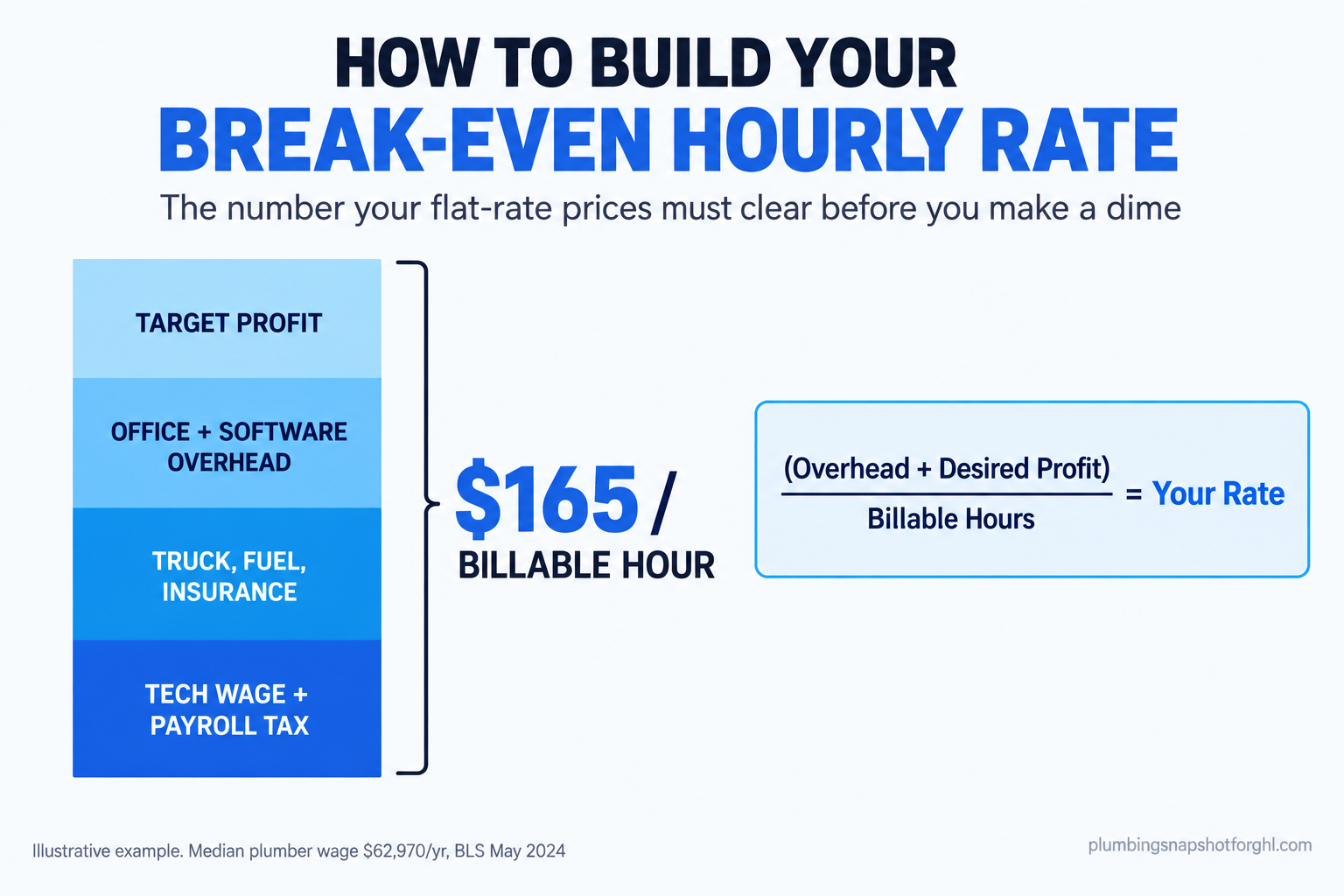
The trap is billable hours. A tech is on the clock 2,080 hours a year, but drive time, restocking, and callbacks mean maybe 1,200 to 1,400 actually land on an invoice. Divide by the honest number, or you’ll price to lose money on every slow week.
Then add profit. To hit a 30 percent net margin, divide your break-even rate by 0.70, not multiply by 1.30 (ServiceTitan). That margin-versus-markup slip is the most common one small shops make. A $115 break-even becomes a billable target of about $164, and that target rate is the engine behind every price in Stage 3.
Stage 2: List your top 40 jobs
Don’t price your whole catalog on day one. Pull your last 6 to 12 months of invoices and sort by how often each job shows up. The pattern appears fast: water heater swaps, drain clears, faucet and fixture replacements, toilet rebuilds, disposals, hose bibs, and pressure regulators make up the bulk of a residential day.
Write down the top 40 by frequency. That’s your minimum viable price book: short enough to finish this week, and it covers most of what your techs see. The long tail of oddball jobs can stay “custom quote” until the core book is running. Trying to price 400 tasks before launch is how price books end up half-built and unused.
Group the 40 into categories your techs think in: water heaters, drains and sewer, fixtures, repairs, and maintenance. A tech should find the right line in under 15 seconds, or they go back to guessing.
Stage 3: Price each task
Now put a number on each of the 40. Estimate the realistic labor time (setup, cleanup, and testing, not just wrench time), multiply by your billable target rate from Stage 1, then add parts at your marked-up cost. Round to a clean number.
Sanity-check each price against what the market charges. Published 2026 ranges give you goalposts: a standard tank water heater install runs roughly $1,200 to $2,500, tankless higher (Angi, This Old House); drain cleaning by snake typically lands $150 to $400 (Angi); a bathroom faucet replacement averages around $270 (Angi). Your number should sit inside those ranges, set by your costs, not copied off a competitor.
Typical 2026 U.S. price points for common residential plumbing jobs. Source: Angi and This Old House.
The point isn’t to copy these figures, it’s to see the spread. A consistent margin across every job keeps you profitable on small tickets and competitive on big ones.
Stage 4: Build good, better, best
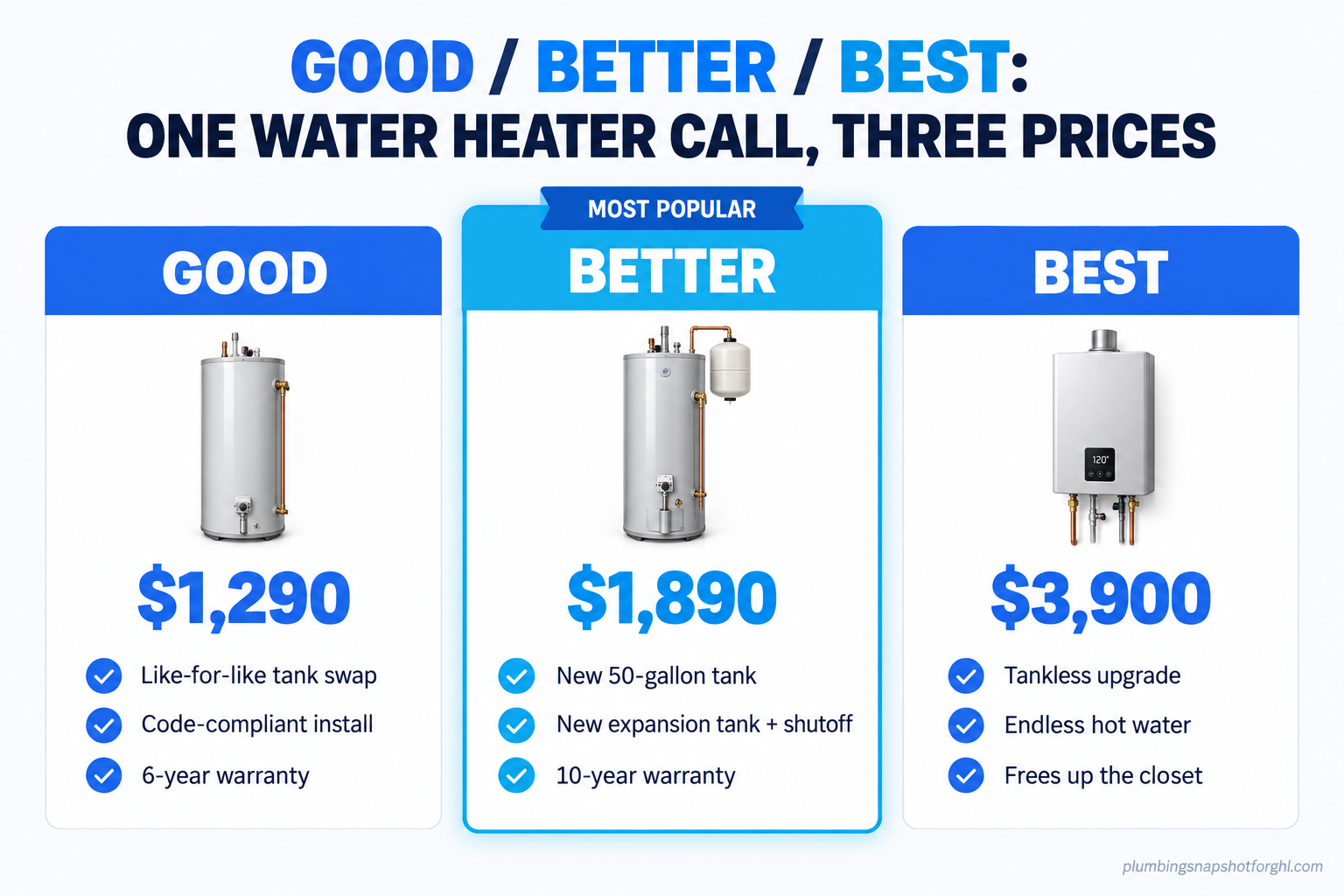
Once priced, wrap the bigger jobs in three options. For a water heater: good is a like-for-like tank swap, better adds an expansion tank, new shutoff, and a longer warranty, best is a tankless upgrade with the works.
This is not a gimmick. Harvard Business Review’s analysis of good-better-best pricing found the structure reliably lifts revenue, with the top tier capturing 30 to 50 percent of sales and the entry tier keeping price-shoppers from walking (HBR, 2018). The middle gives most customers a comfortable place to land, and “best” quietly raises your average ticket. ServiceTitan says shops on its flat-rate Pricebook Pro see about a 13 percent year-over-year revenue increase (ServiceTitan). Treat that as a vendor’s number, but it matches what seasoned service managers see.
Illustrative revenue share across a three-option offer; the top tier commonly captures 30–50%. Source: Harvard Business Review, 2018.
Keep it to three. Two options feel like a trap, and four or more create paralysis at the door. The homeowner wants a clear choice, not a menu.
Stage 5: Present it the same way every time
A price book only works if the customer sees it the same way on every call. The tech shows the price on a screen or a printed sheet, not scribbled on the back of a card. An itemized number feels fixed and fair and takes the negotiation off the tech. The book quoted the price, not the person.
The sequence matters. Diagnose first, present all three options together (best first), then go quiet and let the customer choose. Techs who lead with the cheapest option anchor the conversation low, and techs who quote before explaining the problem sound like salespeople. This is the flow our photo-backed quoting system is built around, because a picture of the corroded tank next to the number closes far better than a verbal estimate.
Stage 6: Get the tech to actually follow it
This is where most price books die. You hand it out, and three weeks later your senior tech is freelancing prices because “the book was too high for that customer.” A book the crew ignores is worse than no book: now your numbers are inconsistent and you think they aren’t.
Three things make it stick. First, pay for it: tie a slice of the tech’s pay to average ticket or book usage. Second, roleplay it until the presentation is automatic, because a tech who fumbles the script drops the price to escape the discomfort. Third, review the exceptions in the morning huddle instead of policing them. Sometimes the book is wrong; usually the tech just got nervous.
Stage 7: Update it every quarter
Costs move: copper, water heaters, fuel, wages. A book set in January and forgotten is losing margin by June. Block 90 minutes every quarter to re-check your five highest-volume prices against current parts cost and your break-even rate. Once a year, rebuild the break-even rate from scratch off the new profit-and-loss statement.
The failure here is neglect. A supplier raises tank prices 12 percent, and every heater you sell for the next eight months quietly eats that increase. The book is a living document, not a monument.
Solo, 5-truck, and 15-truck
The framework is the same at every size; what changes is how much you enforce and automate.
Solo owner-operator. You are the tech and the book. A printed or phone-based book of your top 20 jobs stops you from underpricing when you’re tired at 6pm. You don’t need software, you need discipline, and the break-even math matters most because you’re closest to every dollar.
5-truck shop. Consistency across techs is the whole game, and this is where the $460 gap multiplies. Build the full 40-job book, put it on tablets, and tie a slice of pay to average ticket. You can’t ride along on every call, so automating the estimate and the follow-up on unsold options is where you find the next 10 percent without hiring.
15-truck shop. The book is infrastructure. You need software that locks pricing, reporting that shows book adherence by tech, and a manager who owns the quarterly update. Half a point of margin recovered across every invoice funds another truck.
Flat rate vs time-and-materials for a residential shop
| Plan | Time & materials | Flat-rate price book recommended |
|---|---|---|
| Price | Priced by the clock | Priced by the job |
| Feature 1 | Price changes with each tech's mood | Same job, same price, every tech |
| Feature 2 | Fast techs earn you less | Fast techs run more calls |
| Feature 3 | Customer watches the meter run | Customer knows the number up front |
| Feature 4 | Every invoice is a small argument | Book quotes the price, not the tech |
| Feature 5 | Margin leaks invisibly | Margin is set in the office |
Steal this: the price presentation script
Hand this to your techs and roleplay it until it’s second nature. This is the moment the book pays off or falls apart.
After the diagnosis, before the price:
“Okay, here’s what’s going on. Your water heater’s tank is corroded through at the base, that’s the rust you’re seeing, and it’s going to keep leaking. Good news is this is a job we do all day. I’ve got three ways to fix it, and I’ll walk you through all three.”
Presenting the options, best first:
“The complete option is a tankless upgrade, endless hot water and it frees up the closet, $3,900 installed with the permit. Most folks go with the middle option: a new 50-gallon tank, plus a new expansion tank, shutoff valve, and a 10-year warranty, all in at $1,890. And the straightforward option is a like-for-like tank swap, code-compliant, 6-year warranty, $1,290. All three, I can do today.”
Then stop talking. Let them choose. If they hesitate:
“Totally fair to think it over. Which matters most to you, the upfront cost or how long it lasts? I’ll point you to the right one.”
For the price objection:
“I hear you, it’s not a small number. What you’re paying for is that this is done right, to code, today, with a warranty and a licensed plumber behind it, not a callback in three months. The tank swap at $1,290 gets you there for the least up front.”
Notice what’s missing: no apology, no dropping the price to fill the silence. The number is the number, because the office already decided it was fair.
Keep it legal and transparent
Two guardrails. First, give a written estimate the customer approves before you start work. It’s required in many states, and a flat-rate book makes it easy. Second, if you advertise prices or put the book on your website, know your state’s rules. California and Nevada both require your contractor license number in your advertising, and California’s C-36 rules go further on signage (Contractors State License Board). We cover the full picture in our 2026 plumbing marketing compliance guide.
Objections, answered straight
“My market is too price-sensitive for fixed pricing.” Backwards. Price-sensitive customers hate uncertainty most. A clear number they can say yes or no to beats an open-ended meter, and the “good” tier is your answer to the shopper.
“Won’t a printed price scare people off the big jobs?” Only if you present one number. Good-better-best gives the nervous customer a smaller door while giving the ready buyer the premium option. You lose the sale by hiding the price, not showing it.
“I already pay for ServiceTitan or Housecall Pro, don’t I have this?” You have the container, not the contents. Both ship a flat-rate framework, but the prices inside still have to come from your costs, and the training is still on you.
“My techs are plumbers, not salespeople.” Exactly why they need the book. They diagnose, show the screen, and let the customer choose. The book does the selling, which is easier for a plumber than winging a number.
The bottom line
Back to those two techs and the $460 gap. The fix was never a speech about charging more. It was a system: a break-even rate from real numbers, your top 40 jobs priced off it, three options on the big tickets, the same presentation every time, and a quarterly tune-up. Build that and the same job gets the same price no matter who’s driving the truck. Start with the break-even rate this week.
Frequently asked questions
What is a flat-rate price book for plumbers?
It's a list of your common jobs, each with a single fixed price the customer sees before work begins. The price already includes labor, overhead, marked-up parts, and profit. The tech looks up the task and shows the set price, so every tech quotes the same job the same way.
How do I calculate my break-even hourly rate?
Add total payroll (wages plus tax and benefits) and total overhead (rent, insurance, software, trucks, fuel, admin) for the year, then divide by realistic billable hours, usually 1,200 to 1,400 per tech, not 2,080. To add a margin, divide that rate by (1 minus your target): for 30 percent, divide by 0.70.
Is flat-rate pricing better than time and materials for plumbers?
For most residential service shops, yes. It gives the customer certainty and pays you the same whether your fast or slow tech does the job, so speed becomes profit. Time and materials still fits large commercial or remodel work where scope isn't knowable up front.
How many prices should be in my price book?
Start with your top 40 jobs by frequency, pulled from the last 6 to 12 months of invoices. That covers most of what your techs see and is achievable in a week. A solo operator can start with 20.
Do I need software to run a flat-rate price book?
No. You can run one in a spreadsheet or a binder, and a solo operator often should. Software helps once you have multiple techs and need to lock pricing and track adherence. ServiceTitan, Housecall Pro, and Workiz include flat-rate catalogs, but the prices inside still have to come from your own costs.
How do I get my techs to actually use the price book?
Tie part of their pay to average ticket or book usage, roleplay the presentation until it's automatic, and review off-book exceptions in the morning huddle. Most of all, show techs their own numbers: when they see the book books higher tickets, the resistance ends.