

The new truck wrap looks sharp. Company name across both doors, phone number a foot tall, a cartoon wrench your kid picked. You paid $1,200 for it and it turns heads. In California and Nevada, that wrap can also earn you a fine, because the one thing it’s missing is the one thing the state requires: your contractor license number. Most operators never find out until a competitor reports them. Here are the three ways a small plumbing shop’s marketing quietly breaks the law in 2026, what each costs, and the plain fix, so you close the gaps this week instead of arguing with a licensing board next year.
In this guide
- What one mistake actually costs
- Trap 1: no license number in your advertising
- Trap 2: texting customers without consent
- Trap 3: the new A2P 10DLC rule for June 2026
- Steal this: the consent copy that keeps you legal
- What this looks like for a solo, a 5-truck, and a 15-truck shop
- Objections, answered straight
- Frequently asked questions
What one mistake actually costs
Compliance feels like paperwork until you attach the numbers. Plumbing is a high-ticket emergency trade: water damage and freezing claims averaged $13,954 per claim over 2018 to 2022, and they’re consistently one of the most frequent and costliest categories of homeowners insurance claims, second only to wind and hail (Insurance Information Institute). That’s the size of the job that rings your phone at 2am, and the whole reason you advertise and text is to catch it, so getting fined or sued for it is the worst kind of own goal. None of these three traps is hard to close. They just sit in the blind spot between “marketing” and “legal,” where a busy owner never looks.
Trap 1: no license number in your advertising
This is the most common trap and the easiest to miss. For years plenty of shops got away with it, and in California and Nevada, you no longer do.
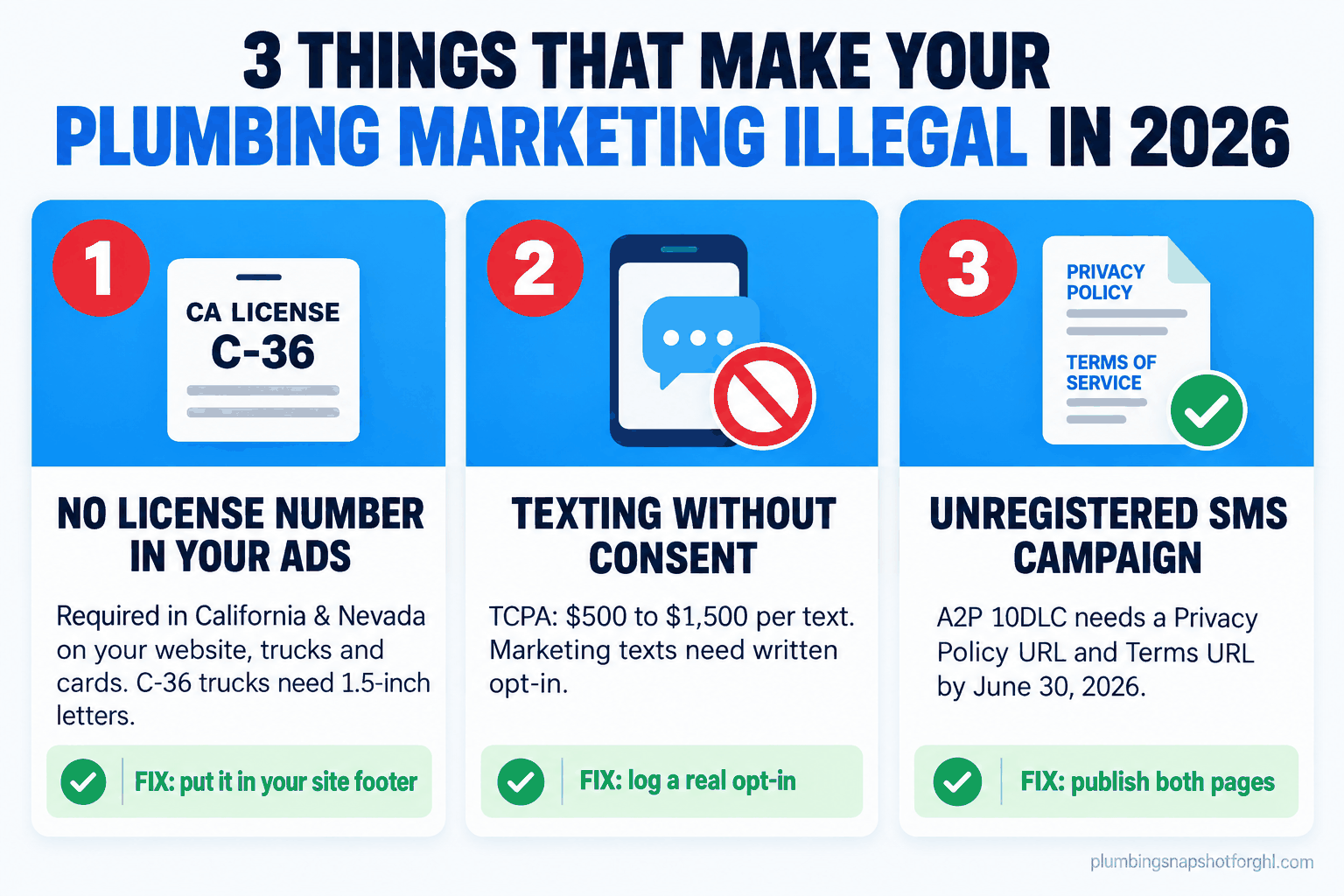
California. The Contractors State License Board requires your license number in every form of advertising, business cards, websites, social media, direct mail, and vehicles included (CSLB advertising guidelines). C-36 plumbing contractors get a stricter vehicle rule than most trades: you must display your company name, permanent business address, and license number on both sides of every commercially registered vehicle, in letters at least 1.5 inches high, where most other contractors need only 0.75-inch lettering. The civil penalty for advertising without your number starts at $100 to $1,000 for a first offense and climbs from there. The rules live in California Business and Professions Code sections 7030.5 and 7029.6.
Nevada. The rule is even more explicit. NRS 624.720(3) states that “all advertising by a licensed contractor must include the name of the contractor’s company and the number of the contractor’s license,” and the statute defines advertising broadly enough to cover your website, trucks, business cards, and any Internet listing (Nevada Revised Statutes 624.720). The Nevada State Contractors Board actively monitors online and print media and issues cease-and-desist orders, with administrative fines running up to $10,000 per violation.
Texas runs a very different system, so don’t assume the California rule applies there. If you operate in Texas, check the current rules with the Texas Department of Licensing and Regulation and the Texas State Board of Plumbing Examiners before you print anything.
How it breaks. The failure is almost never the truck, which a sign shop usually gets right. It’s the website and the social profiles. You launch a new site, the designer never asks for your license number, and now your single biggest advertisement is out of compliance. A boosted Facebook post and a Google Business Profile count too, because every one of those is “advertising” under the statute.
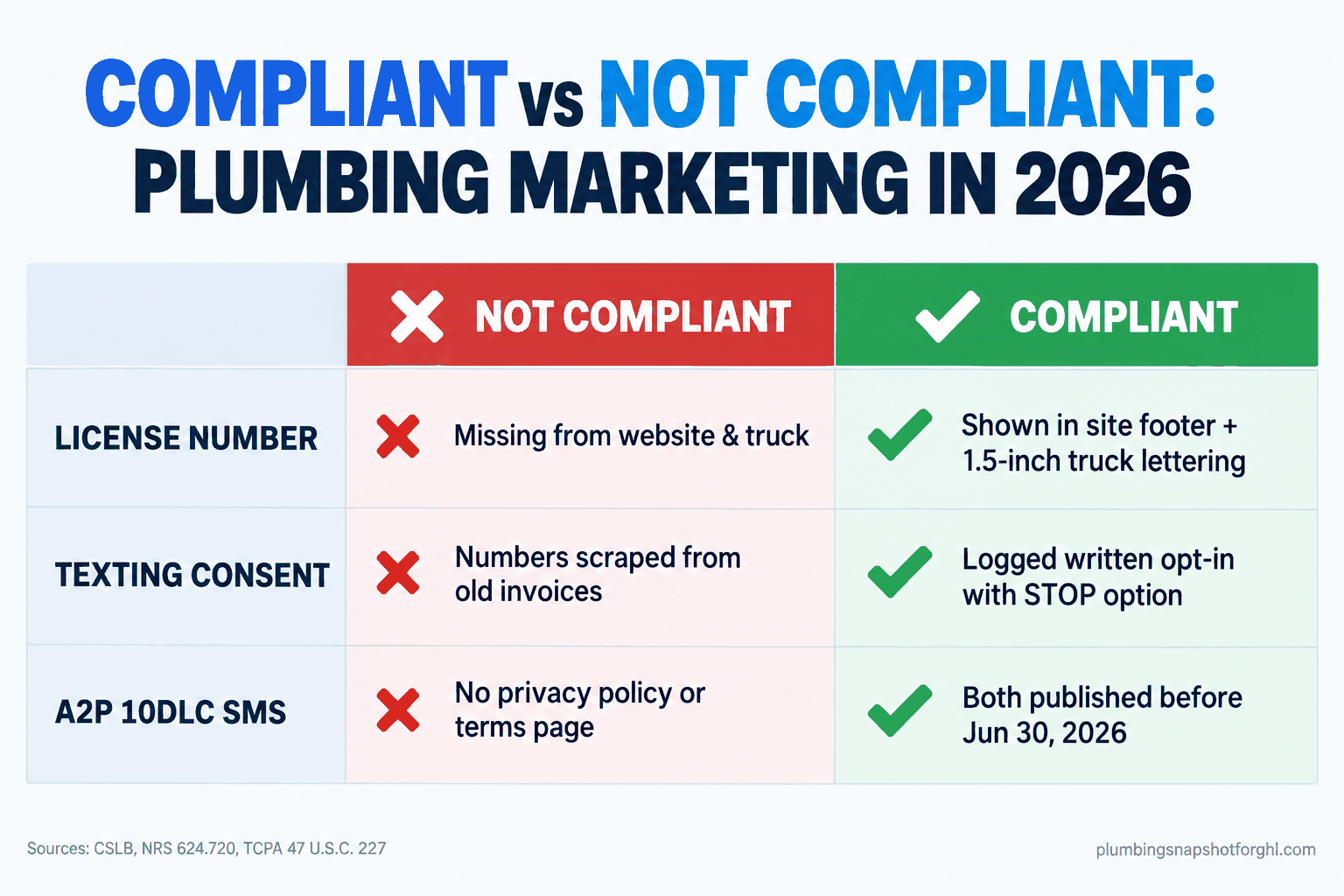
The fix. Put your license number in your website footer so it shows site-wide, then add it to every ad template, your Google Business Profile, your email signature, and your estimates and invoices. Walk the yard with a tape measure and confirm the lettering on both sides of each truck clears 1.5 inches if you’re a California C-36. A one-hour job that removes an entire category of risk.
Trap 2: texting customers without consent
Texting is the highest-converting channel a plumbing shop has, and it’s also the one that generates lawsuits. The Telephone Consumer Protection Act (TCPA) governs how you text and call customers, and the penalties are per message, which is what makes it dangerous.
Here is the distinction that matters. For a transactional or informational text, an appointment confirmation, a “your tech is 20 minutes out,” a “here’s your invoice,” you generally need prior express consent, which the customer gives by handing you their mobile number for that purpose. For a marketing or promotional text, a review request that pushes a promo, a water heater special, a reactivation blast to an old list, you need prior express written consent: a clear, affirmative opt-in where the customer agrees to receive marketing texts. A box they actually check, not a number you scraped off an old invoice.
Get it wrong and the math is brutal. TCPA statutory damages are $500 per text, rising to $1,500 per text for willful violations, with no cap. A single reactivation blast to 1,000 old contacts who never opted in isn’t a $500 problem. It’s a class-action-shaped problem.
Potential TCPA exposure at the $500-per-text statutory minimum, before any willful multiplier. A single non-consented blast to an old list is where small shops get hit. Source: 47 U.S.C. 227 (FCC).
How it breaks. Three ways, over and over. First, the reactivation blast: an owner exports every contact from the old CRM and texts them a promo, none of whom opted in for marketing. Second, the review request that’s actually an ad, because the moment it bundles a discount it needs the higher standard. Third, no record: you had consent but can’t prove it, because it lived in a rep’s memory instead of a timestamped log. In a TCPA case the burden is on you, so “we’re pretty sure they agreed” loses.
The fix. Collect consent at the point you capture the number, with clear language (the copy is below), and log it: date, time, the exact wording, and the source. Keep marketing and service consent separate, honor STOP instantly, and send from a properly registered number, which is Trap 3. Our TCPA compliance breakdown for plumbers covers the consent rules in depth, and the two-way SMS playbook shows how the opt-in fits a real booking flow.
Trap 3: the new A2P 10DLC rule for June 2026
This one is new, and it has a hard date most shops have never heard of. If you send business texts from a normal 10-digit local number, and you do, whether you run GoHighLevel, Twilio, or a field-service app’s texting add-on, those messages travel over a system called A2P 10DLC (application-to-person, 10-digit long code), and your brand and campaign have to be registered with The Campaign Registry. That part isn’t new.
What’s new is the deadline. Starting June 30, 2026, A2P 10DLC campaign registration requires two more fields: a working Privacy Policy URL and a Terms and Conditions URL (Twilio changelog), both pointing to real, public pages on your website. Submit a new campaign registration without them after that date and it’s rejected with a hard error, so your texts don’t send. Existing approved campaigns keep running, but any new registration or change hits the requirement the moment you touch it.
How it breaks. You buy a number for a second location, or your provider asks you to re-register, and the registration bounces because your site has no privacy policy or terms page. Now your “tech is on the way” texts and review requests silently stop, right when you thought you were expanding. For a shop that runs on speed-to-lead, that’s a direct revenue leak, invisible until you notice the reviews stopped coming in.
The fix. Publish a real privacy policy and a terms and conditions page before you register or re-register any campaign. They need to cover how you use phone numbers, that customers may receive texts, and how to opt out. This is a website task, not a phone-system task, which is why it falls through the cracks: whoever set up your texting assumed the site had it, and whoever built your site never knew it was needed.
Steal this: the consent copy that keeps you legal
You can close most of Trap 2 with the right words on your forms. Adapt this language (run it past your attorney first, it’s a starting point, not legal advice).
Two things make this copy work: it’s specific about what you’ll send, and it gives a real opt-out. That’s what a court and a carrier look for, and it’s what keeps customers from reporting your texts as spam.
What this looks like for a solo, a 5-truck, and a 15-truck shop
The rules are the same at every size, but the exposure and the workload aren’t.
Solo operator (one truck, you run everything). Your risk is concentration: the website and the truck are basically your whole marketing footprint, so one missing license number touches almost every ad you have. The fix is fast, though. Add the number to your site footer and your truck, publish a privacy policy and terms page, and set up one registered texting number with a real opt-in on your booking form. An afternoon and you’re clean, and because your volume is low, your TCPA exposure stays low as long as you never blast an old list you can’t prove opted in.
Mid-size shop (5 trucks, an office manager, a dispatcher). Now the traps multiply: five trucks to letter, a website plus a Google Business Profile plus a Facebook page to fix, and real texting volume. This is where consent logging stops being optional, because with a dispatcher and a CSR both texting customers, the opt-in has to live in the system, not in someone’s head. Give one person, usually the office manager, ownership of compliance and make the consent checkbox part of every booking.
Large shop (15 trucks, multiple CSRs, paid ads). At this scale you’re a target. You run Google Ads and Local Services Ads, you have a fleet, and you text thousands of customers a month, so one non-compliant reactivation campaign is a real class-action risk. The fixes here are systems, not tasks: the license number baked into every ad template, a documented consent process every CSR follows, timestamped opt-in logs, automated STOP handling, and A2P registration reviewed whenever you add a number.
Maximum penalty per incident by trap. These sit on different legal bases, per-offense for advertising, per-text for TCPA, so read them as “how bad one mistake gets,” not a like-for-like comparison. Sources: CSLB, NRS 624.720, FCC.
Objections, answered straight
“I’ve advertised for 15 years without my license number and nothing happened.” Enforcement is complaint-driven, so plenty of shops go years without a problem, right up until a competitor reports them or the board runs a sweep. The change in 2026 isn’t the rule, it’s the visibility: your website and social profiles are permanent, searchable, and trivial for anyone to screenshot and report. The old odds don’t apply when your biggest ad is online 24/7.
“Won’t texting consent kill my review requests and reminders?” No, if you set it up right. Service texts, reminders, “tech on the way,” a clean review request, ride on the consent a customer gives when they hand you their number to book. Only marketing, promos, discounts, reactivation blasts, needs the stricter written opt-in. Keep the two streams separate and you keep almost all the conversion with almost none of the risk. The missed-call text-back breakdown shows a compliant flow that still books in seconds.
“Do I need to be technical to handle the A2P thing?” No, but you need it done before June 30, 2026 or on your next registration, whichever comes first. The technical part is your provider’s job. Yours is to make sure your website has a real privacy policy and terms page for them to point at. If it doesn’t, that’s the whole task, and it’s a website task. Compliance and speed-to-lead aren’t opposites, and the after-hours AI receptionist playbook is built around a consent-captured, registered flow for exactly that reason.
Frequently asked questions
Do I have to put my contractor license number on my website?
In California and Nevada, yes. Both states require your license number in all advertising, and their statutes define advertising to include your website. California's rule is in Business and Professions Code section 7030.5 (CSLB); Nevada's is NRS 624.720(3). The simplest fix is to add the number to your site footer so it shows on every page, and to your Google Business Profile and social pages too.
How big do the letters on my plumbing truck have to be in California?
For C-36 plumbing contractors, California requires your company name, permanent business address, and license number on both sides of every commercially registered vehicle, in letters and numerals at least 1.5 inches high. Most other contractor classifications only need 0.75-inch lettering and don't have to show an address, so plumbers are held to a stricter standard (CSLB, B&P Code 7029.6).
What's the difference between consent for a reminder text and a promo text?
An appointment reminder or 'tech on the way' text is transactional and generally needs prior express consent, which a customer gives by handing you their number to book the job. A promotional or marketing text, a discount, a special, or a reactivation blast, needs prior express written consent: a clear, affirmative opt-in where the customer agrees to receive marketing messages. Keep the two on separate consent and log both.
How much can a TCPA violation cost a small plumbing shop?
TCPA statutory damages are $500 per text, rising to $1,500 per text for willful violations, with no cap. Because it's per message, a single non-consented blast to 1,000 old contacts is potential $500,000 to $1.5 million exposure before legal costs, which is why reactivation campaigns to lists you can't prove opted in are the riskiest thing a shop does.
What changes for SMS on June 30, 2026?
From June 30, 2026, registering an A2P 10DLC texting campaign (how business texts from a 10-digit number are sent) requires a working Privacy Policy URL and a Terms and Conditions URL. Submit a new registration without them and it's rejected, so your texts won't send. Existing approved campaigns keep running, but any new number or change triggers it. Publish both pages before you register.
The bottom line
Back to that sharp new truck wrap. Add your license number to both doors, at 1.5-inch letters if you’re a California C-36, and Trap 1 is closed. Put a real opt-in on your booking form and log it, and Trap 2 is closed. Publish a privacy policy and terms page and register your texting properly, and Trap 3 is closed before the June 2026 deadline forces it. None of it is hard, and all of it is invisible until it isn’t. Spend the hour now, because the money you’re protecting, the 2am burst-pipe call, is the job you can’t afford to lose to a fine or a lawsuit.
About the author
Tyler Brennan is the Compliance and Conversion Editor at Plumbing Snapshot for GHL. He spent six years running marketing operations for home-service brands, where he learned the TCPA the expensive way, and he now writes about the overlap between booking more jobs and staying on the right side of the rules that govern how you do it. He writes for owner-operators, plainly, with the statute cited so you can check him.