
The first hard freeze of the winter is either your best payday of the year or the week you hand a dozen jobs to the shop across town. The demand shows up no matter what you do. Pipes burst on their own schedule, usually at 2 a.m., usually all at once, usually while you are asleep. What decides whether that demand turns into collected revenue is not how hard you hustle in January. It is what you wired up in October: who answers the phone at 2 a.m., how fast the on-call tech gets dispatched, whether your pricing is ready, and whether the cash actually lands. This is the full freeze-season playbook, phase by phase, with the moves and the message copy for each.
In this guide
- Why the freeze is the make-or-break season
- What the winter surge is actually worth
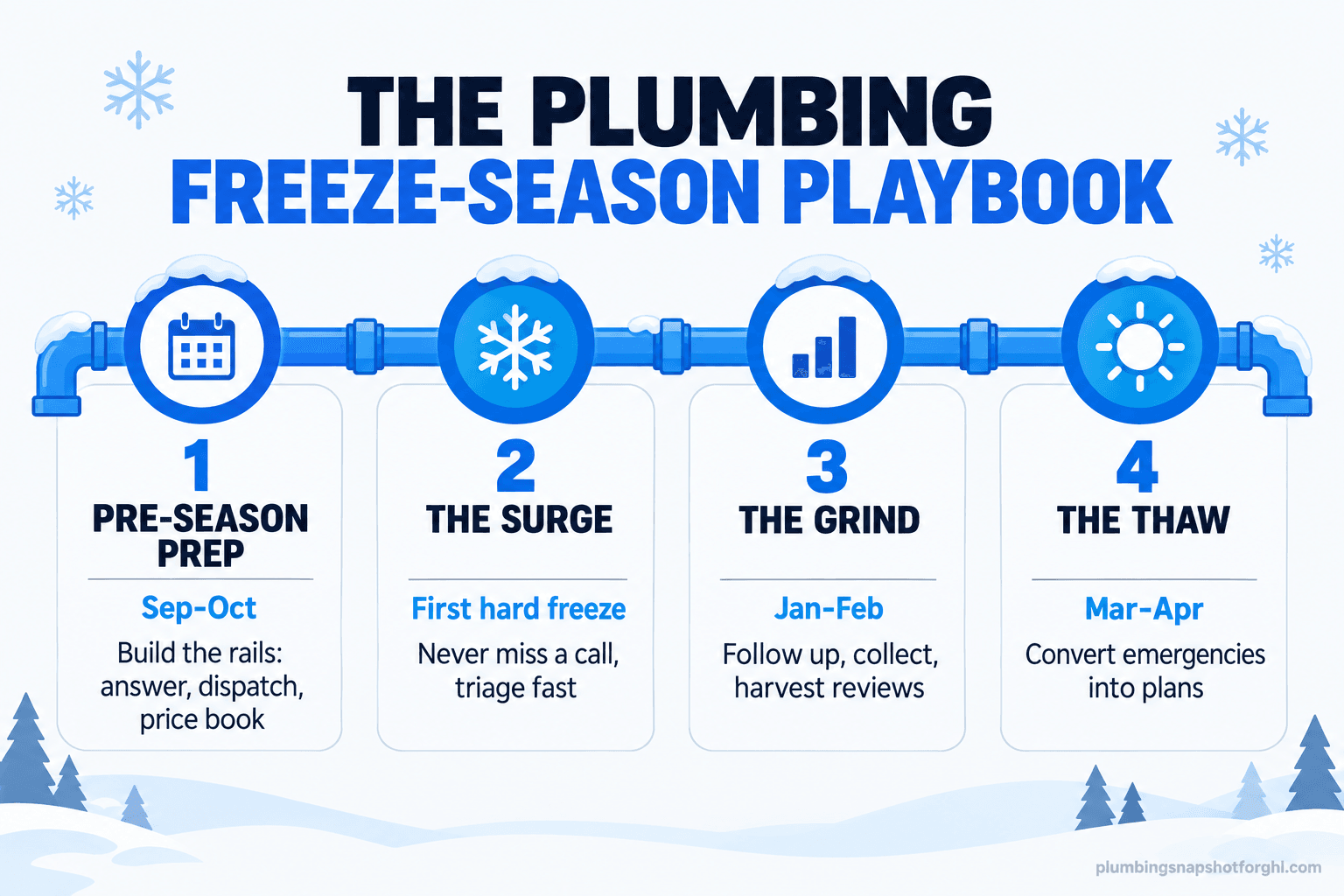
- The operator’s winter in four phases
- Phase 1: Pre-season prep (September to October)
- Phase 2: The surge (the first hard freeze)
- Phase 3: The mid-season grind (January to February)
- Phase 4: The thaw and the slowdown (March to April)
- Steal these freeze-season messages
- How the playbook changes by shop size
- Staying legal when you text the whole list
- Objections
- Frequently asked questions
- About the author
Why the freeze is the make-or-break season
Because the freeze compresses a whole month of emergency demand into about 72 hours, and no crew can flex fast enough to catch it by working harder. Water expands as it freezes and cracks the pipe holding it. When the thaw hits the next afternoon, every one of those cracks starts running, and the calls all land in the same narrow window. You do not get a steady trickle you can staff around. You get a wall.
The homeowner on the other end is not price shopping. They have water coming through a ceiling and a phone in their hand, and the U.S. Department of Energy notes that pipes can begin to freeze once the outside temperature drops to around 20 degrees (DOE). Once a pipe lets go, a crack as small as 1/8 of an inch can spill roughly 250 gallons of water in a day (IBHS, via State Farm). That homeowner will take the first plumber who picks up. Speed of answer beats brand, beats price, beats reviews. It is the whole game for three days.
So the season is not won by the shop with the most trucks. It is won by the shop that captures the most of the demand that was going to arrive anyway. And that capture is an operations problem you solve in the fall, not a hustle problem you solve in the moment.
What the winter surge is actually worth
More than most owners realize, because the tickets are large and they cluster. A freeze job is rarely a $150 fix. It is a burst supply line behind a wall, a cracked slab, a ruined water heater, and often a full mitigation and repipe on the back of it. The insurance data tells the story of the money moving through your market every winter.
Frozen-pipe and freeze-related water-damage claims paid by a single carrier, State Farm, from January 2024 through June 2025. Source: Carrier Management, reporting State Farm figures (January 2026). The five states with the highest paid totals were Illinois, Oregon, Washington, Texas, and Tennessee.
That is one insurer. Zoom out and water damage and freezing is one of the most common property claims there is: about one in 67 insured homes files a water damage or freezing claim each year, based on Insurance Information Institute data for 2019 to 2023 (III). The work is out there, and the trade is not overstaffed to meet it. The Bureau of Labor Statistics counts a median plumber wage of $63,800 and projects about 42,000 openings a year through 2035, growth it calls much faster than average (BLS). Translation: demand spikes, supply is tight, and the shop that answers wins. Now let’s build the season.
The operator’s winter in four phases
The freeze season has a shape, and every phase has a different job. Treat it like four separate campaigns, not one long slog.
| Phase | When | The one job | The biggest leak |
|---|---|---|---|
| 1. Pre-season prep | Sep to Oct | Build the rails: answer, dispatch, price book | Winging the on-call rotation |
| 2. The surge | First hard freeze | Never miss a call, triage hard, dispatch fast | Voicemail at 2 a.m. |
| 3. The grind | Jan to Feb | Follow up, collect, harvest reviews, don’t burn out | Unbilled and unsold work piling up |
| 4. The thaw | Mar to Apr | Convert emergencies into plans and reviews | Letting one-time customers vanish |
None of these needs more marketing spend. Every phase is about capturing and keeping demand you already have coming. Walk them one at a time.
Phase 1: Pre-season prep (September to October)
This is the phase that decides the season, and it is the one most shops skip because in October nobody is calling about frozen pipes yet. That is exactly why it works. You are building the machine while it is quiet, so it runs itself when it is loud.
Four things have to be ready before the first freeze:
- An after-hours answer that is not voicemail. Decide right now what happens when someone calls at 2 a.m. in January. If the honest answer is “it goes to voicemail,” you have already lost. Set up an instant missed-call text-back and a 24/7 answer, whether that is a live on-call phone, a service, or an AI receptionist. Build it in the after-hours AI receptionist playbook and missed-call text-back for plumbers.
- An on-call rotation your techs actually agreed to. Do not improvise this in a snowstorm. Set the rotation, the pay, and the escalation path (who gets called if the first tech does not answer in 10 minutes) in October, in writing.
- A freeze-ready price book. Flat-rate good/better/best for the jobs you will run all winter: frozen-pipe thaw, burst supply line, water-heater replacement, repipe. When the tech can present a menu instead of inventing a number at midnight, quoting is fast and consistent.
- A proactive customer list. Your past customers and maintenance-plan members are the warmest leads you have. A single “cold snap is coming, here’s how to protect your pipes” text in November does two things: it prevents some emergencies (goodwill) and it puts your name back on the phone of every homeowner right before the season.
Phase 2: The surge (the first hard freeze)
The forecast calls for a hard freeze, and 36 hours later your phone does not stop. This is the phase everyone pictures when they think of winter, and the entire job is capture and triage. You cannot physically do every job in the window, so the goal is to catch every opportunity, sort them fast, and not lose the ones you cannot reach today.
Start with the math on the leak. When a shop without an after-hours system hits a surge, the calls stack up faster than a human can answer, and the ones that roll to voicemail are simply gone. Here is what a single freeze night looks like for an unprepared three-truck shop against one that wired up Phase 1.
Illustrative freeze-night capture for a prepared 3-truck shop with instant text-back and 24/7 answer. An unprepared shop with the same 40 calls typically loses 10 to 12 straight to voicemail, since roughly 27% of home-services calls go unanswered. Booking and answer benchmarks from WebFX home-services data.
The moves during the surge:
- Answer or text back every call within seconds. The instant text-back is what buys you the lead while your crews are already on jobs. It turns “they got voicemail and called the next guy” into “they got a text in 20 seconds and waited for you.”
- Triage hard. Not every call is a today call. A slow drip behind a wall can wait two days. A ceiling actively raining cannot. Sort by severity, book the true emergencies first, and queue the rest with a real time window.
- Be honest about capacity. The worst thing you can do in a surge is promise a two-hour arrival and show up the next afternoon. A homeowner will wait if you tell them the truth. They will torch you in a review if you lie. A clear “we are slammed by the freeze, your window is tomorrow between 8 and noon” keeps the job and the reputation.
- Dispatch on speed. Contacting a lead within 5 minutes instead of 30 makes you about 21 times more likely to qualify it (MIT / InsideSales). In a surge that multiplier is everything.
Phase 3: The mid-season grind (January to February)
The adrenaline of the first freeze is gone, but the work is not. This is the long middle, and it is where good shops quietly bleed money, because the back office falls behind while the trucks run flat out. Three leaks open up in the grind.
Unsold estimates pile up. During the surge you quoted repipes and water-heater replacements that the homeowner said they would “think about.” Those quotes are sitting on kitchen counters. Roughly 80% of sales close on the fifth touch or later, yet 44% of reps quit after one (Invesp). Most plumbing shops follow up zero times in January because they are too busy. An automated follow-up cadence fixes this without adding a task to anyone’s day. The full sequence is in plumbing estimate follow-up.
Cash gets stuck. The work is done, but the invoice goes out four days late or never, because the paperwork is buried in a truck cab. Cash flow, not profit on paper, is what strangles a busy shop in winter. Invoice on site, take a card on file at booking, and let the system chase the balance.
Reviews go uncollected at the exact moment they matter most. Every freeze job is a homeowner who is genuinely relieved and grateful, which is the perfect moment to ask for a Google review. Miss that window and you are collecting reviews in July instead, when nobody is searching “emergency plumber near me.” Fire the review request automatically the day the job closes.
The other grind risk is your people. Freeze season burns out techs and dispatchers fast, and a burned-out crew makes mistakes that cost you callbacks and reviews. The single highest-leverage thing you can do for your team in the grind is take the after-hours phone off their shoulders. If a system is catching, texting, and triaging the 2 a.m. calls, your on-call tech sleeps until there is a real emergency, and shows up sharp.
Phase 4: The thaw and the slowdown (March to April)
The freeze breaks, the panic calls stop, and here is the mistake almost every shop makes: they exhale and let all those winter customers disappear. That is the most expensive miss of the whole season, because you already paid, in sleepless nights, to win those people. Winning them again is nearly free.
The thaw is a conversion phase. You have a database full of homeowners who just learned, the hard way, that plumbing emergencies are real and expensive. That is the easiest maintenance-plan pitch you will ever make.
- Convert emergencies into plans. Every freeze customer gets a maintenance-plan offer within two weeks of the job, while the memory is fresh. “We fixed the burst. Want us to catch the next one before it happens?” is a layup in March. Build the mechanics in the maintenance-plan flywheel.
- Run a review push. If you were too slammed to ask during the grind, ask now. A batch review request to your winter customers rebuilds your local ranking right before spring.
- Reactivate the ones who slipped. Some winter calls you could not reach in time, and some quotes never closed. A spring reactivation to that list recovers a real slice of it. See database reactivation for plumbers.
- Debrief for next year. Pull the numbers while they are fresh: how many surge calls came in, how many you captured, where the rotation broke, what you turned away. Phase 1 for next winter starts with this debrief.
The shop that runs Phase 4 well starts every spring with more plan members, more fresh reviews, and a warm list. The shop that skips it starts from zero and does the whole exhausting thing again next November.
Steal these freeze-season messages
The whole playbook runs on a handful of short messages. Here they are, ready to load. Keep them plain, keep them human, and keep the opt-out on the proactive and marketing-style ones.
Six messages carry the entire season. That is the point: the plays are not complicated, they just have to fire every single time, which is exactly what an exhausted human in the middle of a surge cannot promise and a workflow can.
How the playbook changes by shop size
The four phases are universal, but where you are most exposed depends on your size. Run the diagnosis for yours.
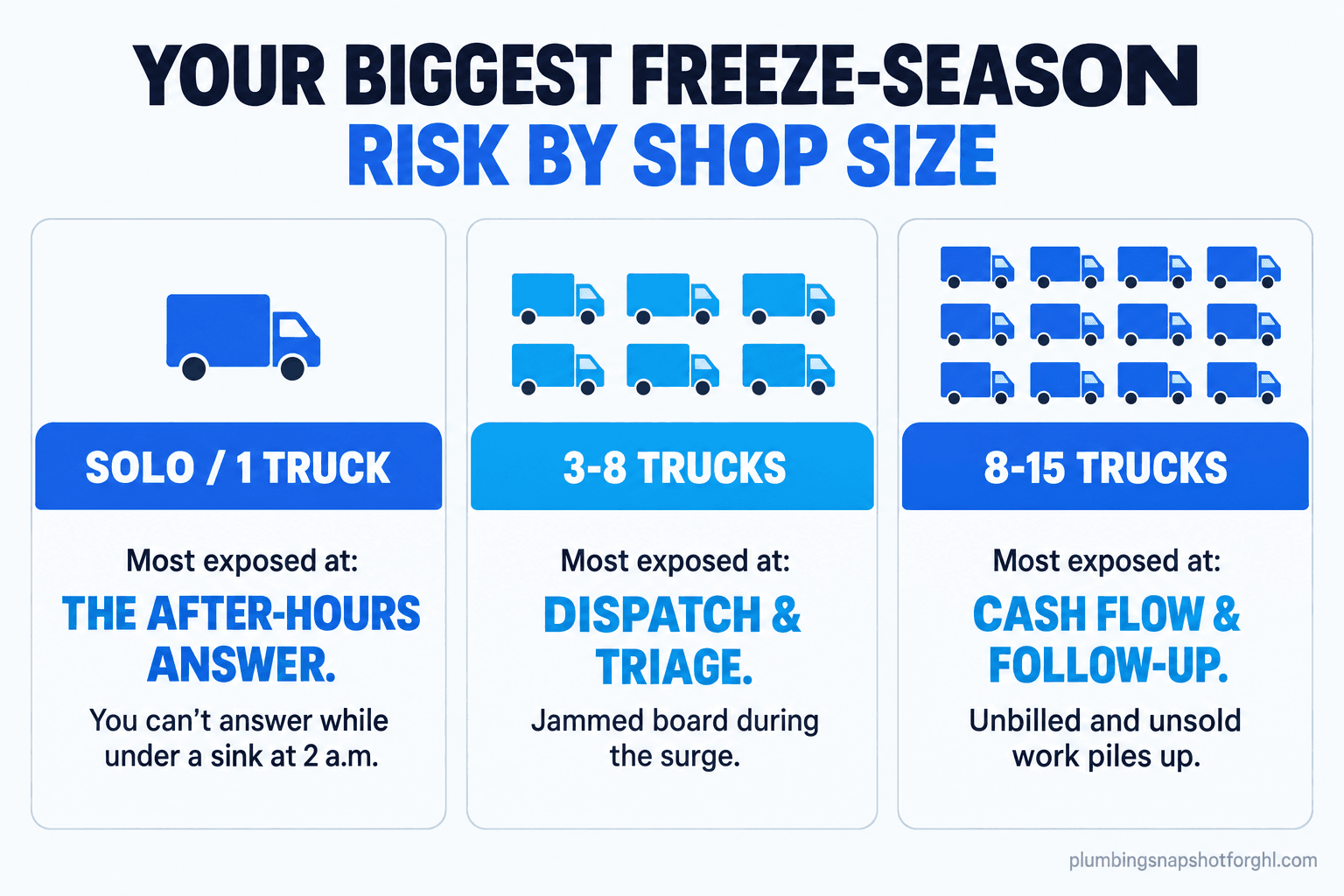
The solo operator (1 truck). Your exposure is the after-hours answer, full stop. You are the truck and the phone, and you physically cannot answer while you are shoulder-deep in someone’s crawlspace at midnight. During a surge you will miss the most calls of any size, purely because there is one of you. An instant text-back plus a 24/7 answer is the highest-return dollar you can spend before winter, and it pays for itself the first burst pipe you catch instead of sleep through.
The mid-size shop (3 to 8 trucks). You have someone answering now, so your exposure moves to dispatch and triage during the surge. Your leak is not missed calls, it is a jammed board: emergencies booked out of order, techs sent across town and back, and customers promised windows you cannot hit. A clear triage rule and automated dispatch texts are worth more to you in January than another truck you cannot staff.
The larger operation (8 to 15 trucks). Your volume means your exposure is in the grind: cash flow and follow-up. At your scale, a four-day invoicing lag across dozens of winter jobs is real money frozen in receivables, and the repipe quotes you did not follow up on add to six figures fast. Same-day invoicing with a card on file and an automated follow-up cadence is where your recovered dollars are hiding.
Staying legal when you text the whole list
The moment you send a proactive freeze-warning blast or automated review requests, you are operating under TCPA and A2P 10DLC rules. This is not a reason to avoid it, it is a reason to do it right, and the basics are simple.
Register your sending number with the carriers through A2P 10DLC or your texts get filtered before anyone reads them. Only text people who gave you consent, which your past customers and plan members did when they hired you and agreed to communications. Put a clear opt-out (“Reply STOP”) on the proactive and marketing-style messages and honor it instantly. Keep non-emergency texts inside legal hours. And note the newer requirement that your campaign registration carry a privacy policy and terms URL, which took effect in 2026. Replying to a homeowner who just called you at 2 a.m. is plainly defensible. Blasting a purchased list you have no relationship with is not. The full framework is in TCPA compliance for plumbing SMS and the 2026 plumbing marketing compliance guide.
Objections
“I just work more hours during the freeze. I don’t need software for a few busy weeks.” More hours does not solve the surge, because the demand arrives faster than any single human can answer. You cannot be on a job and answering the next three calls at the same time. The playbook is not about working less, it is about not dropping the calls your hands are too full to catch. That is a capture problem, and no amount of hustle fixes a phone that rang while you were under a sink.
“Homeowners understand if they get my voicemail at 2 a.m.” They understand, and then they call the next plumber, because their ceiling is coming down. A homeowner with an active flood is not evaluating your work-life balance, they are solving a crisis in the next ten minutes. Understanding and waiting are different things. The plumbing answering service math is brutal on this point.
“I don’t need software, I need more techs.” Maybe, but you cannot hire your way out of the surge either. With about 42,000 plumber openings a year and a tight labor market (BLS), licensed help is hard to find and you will not staff up in time for a freeze that arrives in 36 hours. Capturing and triaging demand well lets the crew you already have do more of the high-value work and less driving in circles.
“Won’t a proactive freeze-warning text annoy my customers?” Not if it is genuinely useful and you have consent. A short, plain “here’s how to protect your pipes this week” is a favor, not a pitch, and it lands you as the helpful pro right before the season. Keep it to your real customer list, keep the opt-out on it, and send it once, not five times. Done right, it prevents emergencies and wins goodwill at the same time.
Frequently asked questions
When should a plumbing business start preparing for freeze season?
September and October. By the time pipes are bursting it is too late to build an on-call rotation, a flat-rate price book, or an after-hours answering setup. Prep in the fall, while it is quiet, decides how much of the surge you capture. The single most important item: decide what happens when someone calls at 2 a.m. in January, and make sure the answer is not voicemail.
How much is the winter freeze surge worth to plumbers?
The tickets are large and they cluster: burst supply lines, cracked slabs, ruined water heaters, and repipes, not small fixes. As a market signal, State Farm alone paid more than $628 million on over 20,000 frozen-pipe claims from January 2024 through June 2025, averaging north of $30,000 per claim (Carrier Management). About one in 67 insured homes files a water damage or freezing claim each year (Insurance Information Institute).
What is the single biggest mistake plumbers make during a freeze?
Letting calls go to voicemail. During a surge, calls arrive faster than a busy crew can answer, and about 27% of home-services calls go unanswered even on a normal day (Invoca). A homeowner with water pouring through a ceiling will not leave a message, they call the next plumber. An instant text-back plus a 24/7 answer is the highest-return fix a shop can make before winter.
How should I handle calls I can't get to during a surge?
Triage by severity and be honest about capacity. Sort active floods (today) from contained leaks (a booked window in a day or two), book the true emergencies first, and give everyone else a real time window instead of going silent or overpromising. A clear 'the freeze has us slammed, your window is tomorrow 8 to noon, text us if it floods' keeps the job and the review. A vague 'we'll try' loses both.
Is it legal to send a freeze-warning text to my customer list?
Yes, under TCPA and A2P 10DLC rules. Register your sending number with the carriers, only text people who gave consent (past customers and plan members qualify), include a clear opt-out and honor it instantly, keep non-emergency texts within legal hours, and make sure your campaign registration carries a privacy policy and terms URL, required as of 2026. A useful, opt-out-included warning to your own list is defensible. Blasting a purchased list is not.
What should I do after the freeze season ends?
Convert and keep. In the thaw (March to April), offer every freeze customer a maintenance plan while the emergency is fresh, run a review push to rebuild your local ranking before spring, and reactivate the customers you could not reach or whose quotes never closed. Then debrief the numbers so next year's fall prep is aimed at your real weak point.
Can I set this up without switching my main field-service software?
Yes. The playbook is mostly marketing-side automation: after-hours answering, missed-call text-back, surge triage, estimate follow-up, review harvesting, and proactive customer texts. Those bolt on alongside a dispatch and invoicing tool like ServiceTitan, Housecall Pro, or Jobber. The Plumbing Snapshot wires those flows into GoHighLevel and connects to your booking, so you keep the tools you have and close the gaps they leave open.
Related posts
- The After-Hours AI Receptionist Playbook: build the 2 a.m. answer that catches the surge.
- Missed-Call Text-Back for Plumbers (2026): the instant reply that turns voicemail into booked jobs.
- Plumbing Estimate Follow-Up (2026): the cadence that closes the repipe quotes sitting on kitchen counters.
- The Maintenance-Plan Flywheel: turn one-time freeze customers into recurring revenue.
- Database Reactivation for Plumbers: recover the winter calls you could not reach in time.
- The 2026 Plumbing Marketing Compliance Guide: keep the proactive texts and review requests legal.
Sources
- Carrier Management: Frozen Pipes Lead to $628M in Losses for State Farm (January 2026)
- State Farm Newsroom: Frozen Pipes? Not So Nice! (IBHS 1/8-inch crack / 250 gallons figure)
- U.S. Department of Energy: Don’t Let Your Pipes Freeze (20-degree threshold)
- Insurance Information Institute: Homeowners and Renters Insurance facts + statistics
- BLS: Plumbers, Pipefitters, and Steamfitters (Occupational Outlook Handbook)
- Invoca: How much missed sales calls cost home-services businesses
- MIT / InsideSales: Lead Response Management study (via LeadAngel)
- Invesp: The Importance of Sales Follow-Ups (statistics)
- WebFX: Home Services Marketing Benchmarks
About the author
Hector Salinas is the GHL Automation Lead at Plumbing Snapshot for GHL, based in Phoenix, AZ. He spent nine years dispatching for a 12-truck plumbing operation before he ever touched a CRM, so he learned freeze-season triage the hard way, on the board at 2 a.m. with the calls stacking up. He maps every after-hours call flow, on-call rotation, and emergency-dispatch sequence in the Plumbing Snapshot, and he writes the way he’d brief a new service manager: plainly, with the revenue math attached.
Want the freeze-season machine built for you before the first hard freeze? Get the Plumbing Snapshot, book a demo, or talk to a real person.