
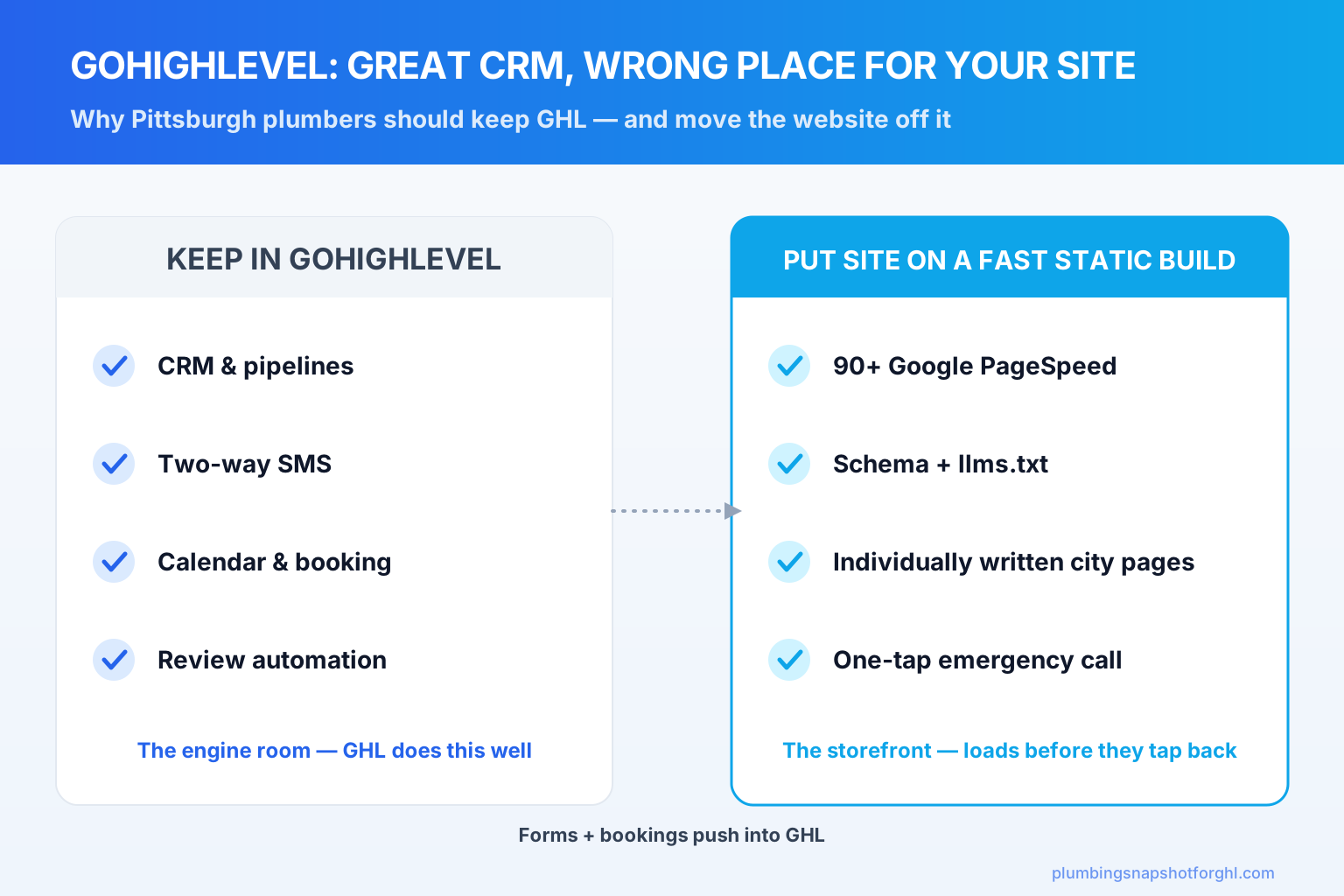
For a Pittsburgh plumbing shop, GoHighLevel is one of the best tools you can run — for the CRM, calendar, SMS, and review automations. It is the wrong place to build your public website. GHL’s built-in page and funnel builder renders a heavy, JavaScript-driven page, so plumbing sites built on it commonly land in the 40–70 range on mobile Google PageSpeed — right where a homeowner staring at a burst supply line taps “back” and calls the next shop. Google found that 53% of mobile site visits are abandoned when a page takes longer than three seconds to load (Google). The fix isn’t to abandon GoHighLevel — it’s to use it for what it’s great at and put your website on a fast static build that still pushes every form and booking straight into your GHL account. You keep the automation hub; you stop leaking the calls that feed it.
In this guide
- The short answer: should Pittsburgh plumbers build their website in GoHighLevel?
- What GoHighLevel is genuinely great at
- Why a page-builder site loses the Pittsburgh emergency call
- Three ways a GHL-built website quietly costs you
- Speed is money: what a faster Pittsburgh site is worth
- The fix: keep GoHighLevel, move the website to a fast static build
- Frequently asked questions
- About the author
- Related reading
The short answer: should Pittsburgh plumbers build their website in GoHighLevel?
No — build the website somewhere fast, and keep GoHighLevel as the engine behind it. This isn’t a knock on GHL. If you’re already running the Plumbing Snapshot on GoHighLevel, you have a genuinely excellent system for the parts that matter after a lead comes in: the CRM, the pipelines, the two-way SMS, the calendar, the review requests. Those are the jobs GHL was built for, and it does them better than almost anything a local shop can afford.
The website is the exception. GHL’s site and funnel builder is a drag-and-drop tool that assembles a page in the browser at load time — the same architecture as every other page builder, and it carries the same tax: a stack of JavaScript, embedded widgets, and tracking that all has to download and run before your phone number paints. On a desktop over office Wi-Fi that’s invisible. On a phone at the bottom of a Pittsburgh basement stairwell, on a cell connection, in a flooding emergency, it’s the difference between a booked job and a bounce.
Pittsburgh makes that gap expensive. This is a metro of old homes — some of the oldest housing stock in the country — where cast-iron drains, galvanized supply lines, and aging water heaters fail on their own schedule, usually at night. When one does, the homeowner does what everyone does now: pulls out a phone, searches, and taps the first result that actually opens. Your website’s only job in that moment is to load before their patience runs out. A page-builder site is the one that doesn’t.
I love GoHighLevel — I build in it every day. But I tell every plumbing shop the same thing: GHL is the engine room, not the storefront. Run your CRM, your texts, and your review automations in it. Don’t ask it to be the fast public page a panicked homeowner loads at 2 a.m. That’s a different job, and speed is an architecture decision you make once.
What GoHighLevel is genuinely great at
Let’s be fair to the platform, because the answer here is “use the right tool for each job,” not “GHL is bad.” For a plumbing operation, GoHighLevel earns its keep on:
- CRM and pipelines — every lead, every job, every stage in one place, so nothing sits in an inbox nobody checks on a Saturday.
- Two-way SMS and missed-call text-back — the automations that hit the speed-to-lead window the moment a call is missed.
- Calendars and booking — self-scheduling, reminders, and no-show recovery wired to your pipeline.
- Review and reputation automation — the review pipeline that fires a request the moment a job is marked complete.
- The whole after-hours system — the AI receptionist and dispatch flows that answer and route the emergency call.
Notice what’s not on that list: being the fast, SEO-optimized public website that wins the search in the first place. GHL is the system that converts and keeps a customer once you have them. Getting found — and loading fast enough to keep the click — is a website problem, and it’s the one place the all-in-one promise breaks down for a service trade.
Why a page-builder site loses the Pittsburgh emergency call
Your buyers rarely browse. They search in a moment of need — no hot water, a slab leak, a backed-up main — tap the top local result, and decide in seconds whether to call or hit “back.” 76% of people who search for something nearby on a smartphone visit a related business within a day, and 28% of those local searches end in a purchase (Think with Google). The intent is already there. The only question is whether your page loads before their patience runs out.
The data on that patience is brutal and consistent. Google found that 53% of mobile site visits are abandoned if a page takes longer than three seconds to load (Google). And it’s not a cliff at three seconds — it’s a slope the whole way down. Google’s machine-learning analysis of real mobile data showed the probability a visitor bounces climbs steadily as pages slow:
Increase in the probability a mobile visitor bounces as page load time grows. Source: Think with Google / SOASTA — Mobile page speed benchmarks.
Now read that against a plumbing emergency. A page-builder site — GoHighLevel, WordPress, or Wix — that limps in at 5–6 seconds on a mid-tier phone on a Pittsburgh cell network carries roughly double the bounce risk of a 1-second static page. Every one of those bounces is a homeowner who dialed the next result. In the emergency segment, that lost click was a same-day water-heater swap, a repipe, or a sewer-line job — often four and five figures each.
Sources: Google — The need for mobile speed, Think with Google / SOASTA, Think with Google — mobile search trends, and HTTP Archive Web Almanac 2025.
Three ways a GHL-built website quietly costs you
A page-builder website doesn’t announce the problem with an error message. It leaks quietly in three places.
1. Speed and Core Web Vitals
A GHL page assembles in the browser: the builder runtime, embedded form and chat widgets, tracking pixels, and any funnel logic all load before the content settles. That’s the same reason builder-heavy platforms struggle on real-world field data — the HTTP Archive Web Almanac 2025, which measures actual Core Web Vitals across millions of live sites, found WordPress passes all Core Web Vitals on only about 43% of mobile sites, near the bottom of the major platforms, while the fastest modern architectures pass at nearly double that rate. Any drag-and-drop builder that ships a runtime to the browser fights the same headwind.
Share of mobile sites passing all three Core Web Vitals, by architecture. Source: HTTP Archive — Web Almanac 2025, Performance (real-user CrUX data).
This isn’t only about the click you lose today. Core Web Vitals are part of Google’s page-experience signals and a ranking consideration (Google Search Central) — a slow site is harder to find and harder to keep once found. If you want the deeper speed breakdown, our post on plumbing website page speed walks through the field metrics.
2. SEO, schema, and AI search you can’t control
Winning “plumber near me” and showing up in AI answers takes structured data, clean meta, individually written city and service-area pages, and an llms.txt file that hands AI answer engines something to quote. GHL’s builder was designed for funnels and landing pages, not for the fine-grained SEO and AEO control a local search strategy needs. When ChatGPT, Perplexity, or Google’s AI Overviews answer “who fixes a burst pipe in Pittsburgh?”, they pull from sites that are structured to be read — and a funnel builder rarely ships that structure by default.
3. Edits you can’t make (or make without breaking speed)
When your after-hours rate changes or you add a page for Mt. Lebanon or Shadyside, you’re either fighting the builder yourself — and hoping you don’t tank the layout or the PageSpeed score — or waiting on someone to do it. A site that’s slow and awkward to update is how a plumbing website quietly rots while you’re out running trucks.
Speed is money: what a faster Pittsburgh site is worth
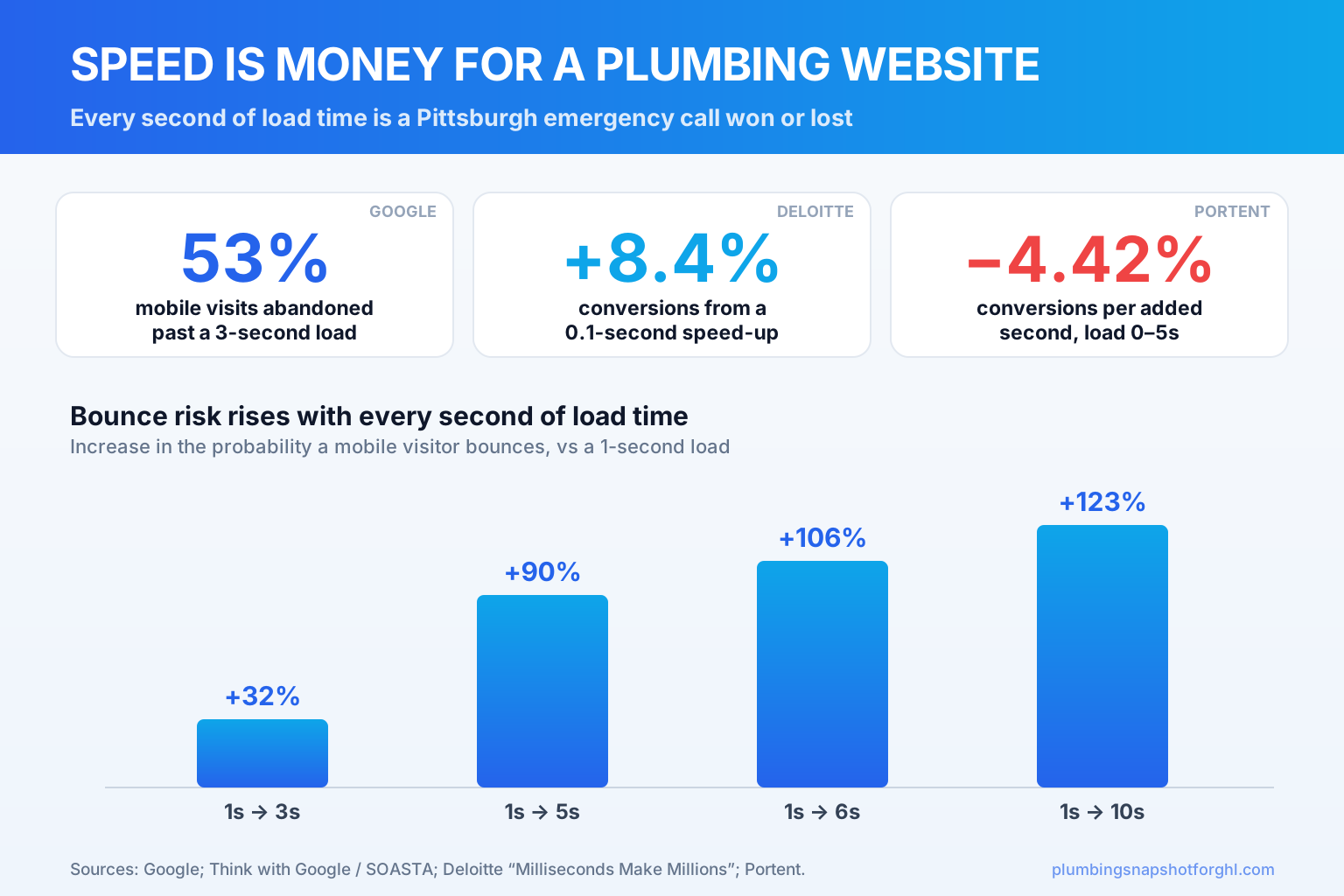
The speed argument only matters if it shows up in booked jobs — and it does. Deloitte’s Milliseconds Make Millions study analyzed more than 30 million user sessions and found a mere 0.1-second improvement in mobile site speed lifted retail conversion rates by 8.4% and average order value by 9.2%, with conversion gains across every vertical it measured (Deloitte / web.dev). A plumbing website is a lead-gen site — its conversion is a booked call, and speed moves that number.
Portent’s analysis of more than 100 million page views put a slope on it: conversion rate drops an average of 4.42% with every additional second of load time between seconds 0 and 5 (Portent). Put Pittsburgh numbers on it. Say local search sends your site 400 mobile visitors a month. If moving from a builder-typical 5-second load to a static-typical 1-second load recovers even a handful of the visitors who’d have bounced, and one of them books a $2,000 water-heater install or a $8,000 repipe, the site has paid for a year of itself in a single job.
Sources: Deloitte — Milliseconds Make Millions (via web.dev) and Portent — Site Speed & Revenue.
The fix: keep GoHighLevel, move the website to a fast static build
You don’t have to choose between GoHighLevel and a fast website. You use each for what it’s best at. Keep GHL as your CRM, calendar, SMS, and review engine. Put your public site on a static architecture — we build on Astro, which renders every page to plain HTML at build time and ships almost no JavaScript — and wire the two together so form submissions and bookings push straight into your GoHighLevel sub-account. The homeowner gets a page that paints in a few hundred milliseconds; you get the lead in the same pipeline you already run.
Here’s the honest side-by-side for the one thing that matters — booking the Pittsburgh call:
| What matters for a plumbing site | Website built in GoHighLevel | Fast static site (+ GHL behind it) |
|---|---|---|
| Google PageSpeed (mobile) | Commonly 40–70 once widgets load | 90+ guaranteed, often 100 |
| How pages are served | Assembled in the browser at load | Pre-built static HTML from the edge |
| JavaScript shipped | Builder runtime + widgets on every page | Near-zero; interactive islands only |
| Core Web Vitals | Fights the same builder headwind | Passes by default |
| Schema, AEO & llms.txt | Limited / manual | Shipped on every page |
| City & service-area pages | Awkward in a funnel builder | Individually written, each with its own schema |
| Leads land in GHL | Yes (native) | Yes — pushed in via API/Zapier/Make |
| Your CRM, SMS, reviews | Stay in GoHighLevel | Stay in GoHighLevel |
The bottom row is the point: you keep GoHighLevel. Nothing about a fast website means leaving the automation hub you’ve already built. It means the front door loads instantly instead of buffering while a homeowner dials someone else. Our done-for-you website service builds exactly this — a guaranteed 90+ PageSpeed Astro site, individually written city pages, schema and llms.txt baked in, and every form forwarded into whatever you already run, GoHighLevel included. If your stack needs a custom two-way connection, our GHL development team wires it.
Frequently asked questions
Is GoHighLevel bad for plumbing websites?
GoHighLevel is excellent for the CRM, pipelines, two-way SMS, calendars, and review automation — that's what it was built for and it does it very well. The website is the exception. Its page and funnel builder assembles pages in the browser and ships a heavy runtime, so plumbing sites built on it commonly score in the 40–70 range on mobile Google PageSpeed. Because 53% of mobile visitors abandon a page that takes longer than three seconds to load, a slow builder site loses emergency calls. The fix is to keep GHL for the CRM and put the public website on a fast static build that still feeds leads into GoHighLevel.
Do I have to leave GoHighLevel to get a faster website?
No. That's the whole point. You keep GoHighLevel as your CRM, SMS, calendar, and review engine. Only the public website moves to a fast static architecture. The two are connected so every form submission and booking on the fast site pushes straight into your GHL sub-account via API, Zapier, Pabbly, or Make — the lead lands in the same pipeline your dispatcher already watches. You lose nothing you built in GHL; you just stop losing calls to a slow page.
Why is a static Astro site faster than a GoHighLevel page?
A static site is rendered to plain HTML at build time and served from a global edge network, so the page arrives finished with almost no JavaScript to download and run. A GoHighLevel page (like any drag-and-drop builder) assembles in the visitor's browser — the builder runtime, embedded widgets, and tracking all load before the content settles. On a phone on a cell connection, that difference is the seconds that decide whether a homeowner calls or taps back. A well-built static plumbing site earns a 90+ PageSpeed score as its normal state, often a clean 100.
Does website speed actually affect my Google ranking in Pittsburgh?
Yes, in two ways. Core Web Vitals are part of Google's page-experience signals and a ranking consideration, so a faster site is easier to rank. And speed affects the behavior Google watches: a page that loads slowly gets abandoned, and those bounces work against you. A fast, well-structured site with proper schema, city pages, and an llms.txt file also stands a better chance of being surfaced in Google's AI Overviews and cited by AI assistants like ChatGPT and Perplexity, which is increasingly where a plumbing job starts.
Will my leads still come into GoHighLevel from a separate website?
Yes. Every form and booking widget on the fast site is wired to forward submissions into your GoHighLevel account — by direct API or through Zapier, Pabbly, or Make. The homeowner fills out the form on a page that loaded instantly; the contact, job details, and tags appear in your GHL pipeline exactly as they would from a native GHL form, ready to trigger your existing automations. Nothing about your CRM workflow changes.
How much does a done-for-you fast plumbing website cost?
Our Get a Website service is billed monthly with a one-time build fee that's only charged after the site is live and you've signed off on it. Every plan includes a guaranteed 90+ Google PageSpeed score, individually written city and service-area pages, schema and llms.txt for AI search, and a set number of change requests each month at no extra cost. The fastest way to a real number for your shop is a short call — pricing and what's included are laid out on the Get a Website page.
About the author
Hector Salinas is the GHL Automation Lead for Plumbing Snapshot for GHL, based in Phoenix, AZ. He spent nine years dispatching for a 12-truck plumbing operation before he ever touched a CRM, and learned the hard way how a single dropped call turns into a lost five-figure job. He builds in GoHighLevel every day — and is the first to say the website is the one job to keep out of the funnel builder. He writes the way he’d brief a new service manager: plainly, with the revenue math attached.
Related reading
- Astro vs WordPress for Plumber Websites (Houston) — the speed case, platform by platform.
- Wix vs a Custom Website for Plumbers (Orlando) — the same trade-off, a different builder.
- Plumbing Website Page Speed, Explained (Atlanta) — the Core Web Vitals field metrics that decide the call.
- Getting Found by AI Search as a Plumber (Tampa) — schema, llms.txt, and being the answer AI assistants quote.
- GoHighLevel for Plumbers — the CRM and automation hub your fast site plugs into.
- Get a Website for Plumbers — the done-for-you Astro build, wired to your GoHighLevel account.