
The estimate is sitting on the kitchen counter. You wrote it after you pulled a section of 55-year-old galvanized and showed the homeowner the rust choking the pipe to a straw. Seven grand to repipe the whole house in PEX. They nodded. It made sense. Then came the five words that cost you the job: “Let me think about it.” Three weeks later they called the shop with the loud radio ad, because that guy offered a payment plan.
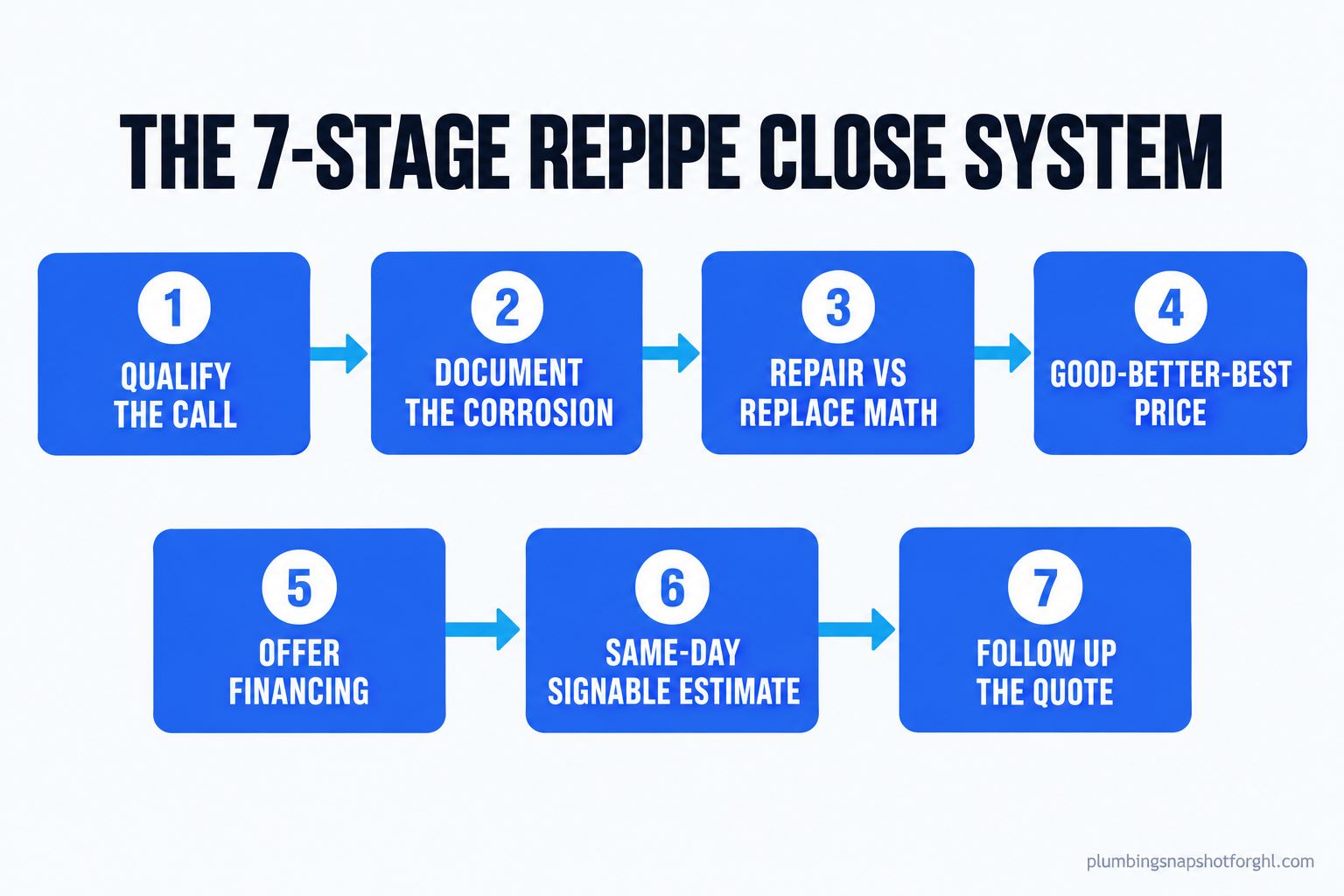
A whole-home repipe is the biggest residential ticket most plumbers write, and most get under-sold or lost at the kitchen table. You do not fix that with a harder pitch. You fix it with a system: qualify the call, document the corrosion with photos, show repair versus replace with the math, price it good-better-best, offer financing, send a same-day signable estimate, and follow up the ones that do not sign on the spot. The average U.S. homeowner spends about $7,500 to repipe a house, most jobs between $1,500 and $15,000 (Angi, 2026). Miss one a month and you left a truck payment on the counter. This is the full playbook: the seven stages, the scripts to steal, and what each lost one costs.
In this guide
- Why you keep losing the repipe
- What a lost repipe actually costs you
- The 7-stage repipe close system
- Steal this: the exact repipe scripts and texts
- How the repipe system changes by shop size
- Common objections, answered
- Frequently asked questions
Why you keep losing the repipe
A repipe is an easy job to diagnose and a hard job to sell. You know the house needs it. The homeowner is not so sure, because to them it is a big scary number attached to a problem they cannot see inside the walls. Here is where it slips.
You treat it like a repair call, not a decision. A cartridge swap is a yes or no. A repipe is a household spending a chunk of its savings, so quoting it like a faucet, a flat number and no context, loses.
You scare instead of show. “Your pipes are shot” sounds like every upsell they have been burned by. The plumber who shows the rust closes; the one who says “trust me” gets “let me think about it.”
You make price the whole conversation. With only $7,500 on the table and no way to pay over time, price becomes a wall. They are not saying it is not worth it. They are saying they do not have $7,500 in checking this week.
You leave a paper quote and never follow up. A number on a carbon form goes cold the second you leave. The estimate not signing on the first visit is normal for a job this size, but most shops treat silence as a no, so the job goes to whoever circled back.
Every one is a process gap, not a skill gap. Your techs are not bad at plumbing. The shop is bad at turning a correct diagnosis into a funded decision, and that is fixable with a system.
What a lost repipe actually costs you
A lost repipe costs three ways: the ticket you walked away from, the emergency you are inviting, and the referrals that never happen.
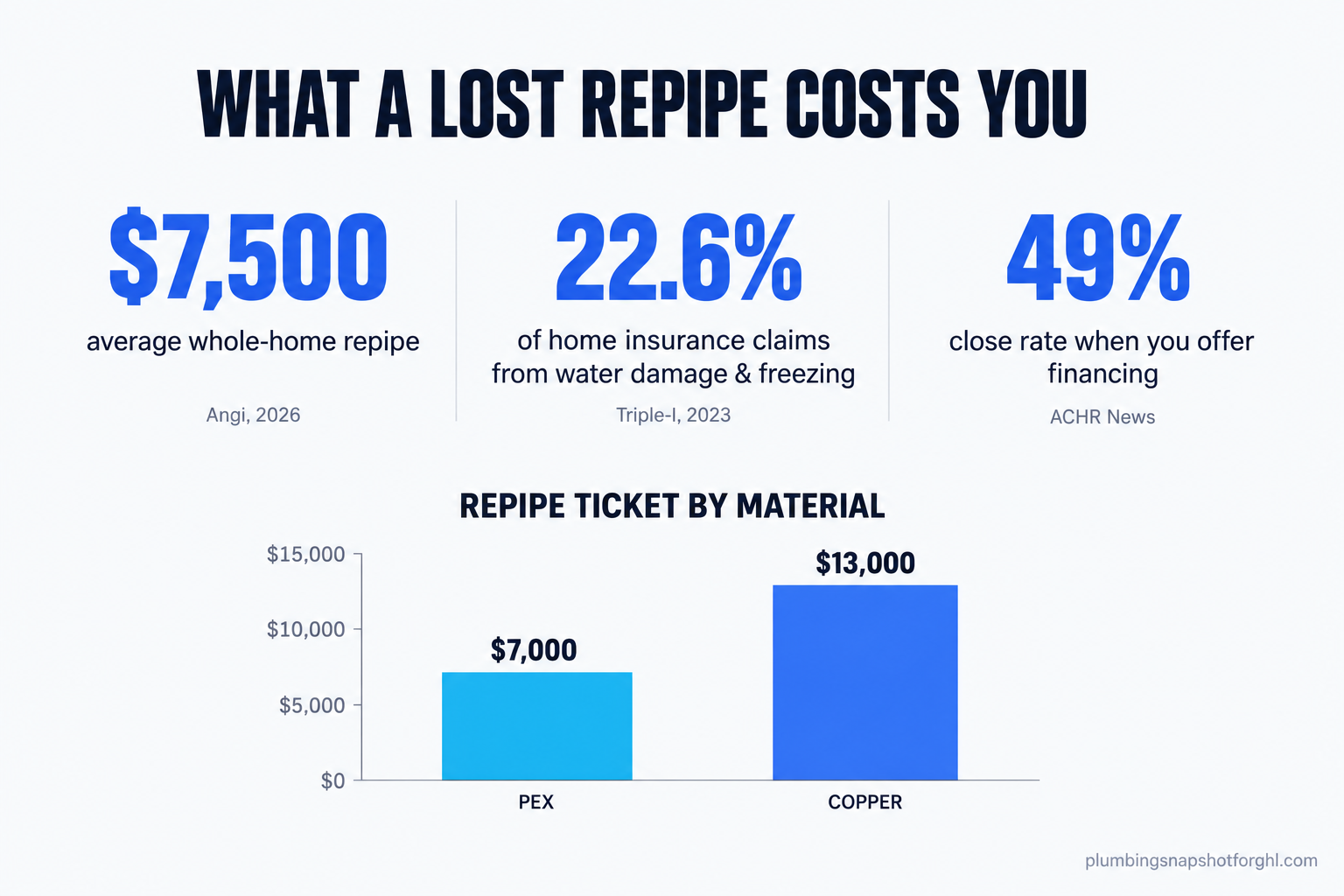
Start with the ticket. At an average repipe near $7,500 (Angi), one lost job a month is $90,000 of top-line revenue in a year, and it would take a stack of service calls to replace that. The repipe is the most efficient revenue a residential plumber can book.
Then the emergency you are inviting. Aging pipe does not fail politely. Galvanized steel corrodes from the inside until it chokes to a trickle, and polybutylene fails internally with no warning until it bursts (This Old House). When it goes, it goes into the walls. Water damage and freezing claims now average about $15,400 and made up 22.6% of all homeowners insurance claims in 2023, with roughly 1 in 67 insured homes filing one every year (Triple-I, via This Old House). The repipe you did not sell is the flooded drywall six months from now, often called in to a different plumber.
Typical whole-home repipe ticket in 2026 by material (USD). Sources: Angi, Latestcost.
Last, the referrals. A homeowner who lets you repipe their house becomes a customer for life and tells the neighbor with the same 1970s plumbing. One you scared off tells nobody.
The 7-stage repipe close system
Here is the system that turns a correct diagnosis into a signed job. Each stage has the setup and, more important, how it breaks. Run them in order on every repipe. None of it is a hard sell. It makes the problem visible, the fix clear, and the yes easy.
Stage 1: Qualify the repipe on the phone, before you roll
Repipe candidates announce themselves if you listen. On the booking call, ask three things: how old is the house, what color is the morning water, and how many leaks lately. A pre-1980 house with rusty water and a second leak this year is a repipe hiding behind a service call. Flag it so the right tech goes with time and a loaded truck.
How it breaks: whoever answers books a one-hour slot and sends a tech with no time for the real conversation. Build the three questions into your intake and booking flow so a likely repipe gets a longer slot.
Stage 2: Diagnose and document the corrosion with photos
This is the stage that closes repipes. When you confirm the pipe is failing, cut out a section if you can and photograph it next to a clean piece: the rust ring choking the inside diameter, the discolored water, the corroded fittings. You are not building a case against the customer, you are building the evidence that lets them decide. A homeowner who sees the straw-sized hole left inside a one-inch pipe does not need a pitch.
How it breaks: the tech diagnoses it in his head, says “you need a repipe,” and never shows the proof, so the customer hears an opinion and goes looking for a second one. Make photos a required step, the same as any photo-backed estimate. No photos, no quote.
Stage 3: Present repair versus replace with the real math
Give the honest comparison, not just the big number. Lay out what spot-repairing this leak costs today, then the next one, and the one after, because on failing galvanized or poly there is always a next one. Then show the repipe as the line that ends the bleeding. When they see that three or four spot repairs plus the water-damage risk cost more than doing it once, the repipe stops looking expensive and starts looking like the cheap option.
How it breaks: you present only the repipe number with nothing to compare it to, so it floats there as a scary $7,500. Or you oversell and claim the house floods tomorrow, which reads as a scare tactic. Anchor it against the running cost of not doing it.
Stage 4: Build a good-better-best price with material options
One take-it-or-leave-it number gives the customer one decision: yes or no. Three options give them a better one: which. Offer PEX as the value option, since it runs far cheaper than copper for the same house (Latestcost), a copper option for the buyer who wants it, and where it fits, a phased plan that does the worst lines now and the rest next quarter. You meet different budgets without discounting.
How it breaks: the tiers are three versions of the same thing, so the customer sees through it, or you lowball the good tier until it kills your margin. Make each tier genuinely different, price each to make money, and price it all off your real billable rate.
Stage 5: Offer financing so price stops being the wall
This is the single biggest lever on a repipe, because the objection is almost never “it is not worth it.” It is “I do not have $7,500 this week.” A payment plan turns it into a monthly number they can say yes to today. The data is not subtle: contractors who offer financing report close rates climbing from 38% to 49% (ACHR News) and tickets 13 to 16% higher (ServiceTitan). Put the monthly payment right next to the total, every time.
How it breaks: the tech mentions financing as an afterthought at the door. Make the monthly figure part of the estimate, next to the cash price, so every customer sees “or about X a month.” Our financing playbook covers setting it up without eating the fees.
Stage 6: Send the estimate same-day, digital, and signable
The repipe they can sign from the couch beats the one scribbled on a carbon copy. Before the tech leaves, the homeowner should have a clean estimate on their phone: the photos, the three options, the monthly payment, and a button to approve. The highest-intent moment is right after they saw the pipe, not three days later when the fear fades.
How it breaks: the estimate is a paper form, or a PDF you promise “tonight” and send two days late, by which point the customer cooled off or called someone else. Send it while the tech is on-site, and make approving it a single tap.
Stage 7: Follow up the unsigned estimate, on a schedule
Most repipes do not sign the same day, and that is fine. What is not fine is treating silence as a no. Build a simple cadence: a same-evening recap, a two-day check-in that answers the question they are stuck on, a one-week financing nudge, and a final “we are holding your quote” around day 14.
How it breaks: you follow up once, get no reply, and quit, or you blast the same “just checking in” four times. Each touch should add something: an answer, the monthly payment, a deadline. Automated texting needs consent and a working opt-out under the TCPA, so build consent into the estimate step. The full estimate follow-up sequence has the cadence that wins cold quotes.
The same repipe, two different shops
Tech says 'you need a repipe,' writes $7,500 on a paper form, and leaves. No photos, no comparison, no financing, no follow-up. The quote goes in a drawer and the job goes to the shop with a payment plan.
The call is flagged as a repipe. The tech photographs the corroded pipe, shows repair-vs-replace math, offers PEX/copper/phased options with a monthly payment, and texts a signable estimate before leaving. A four-touch follow-up closes the slow yeses.
Steal this: the exact repipe scripts and texts
Swap in your shop name and reply path. Automated follow-ups need consent on file and a working opt-out, so read the plumbing TCPA guide first.
How the repipe system changes by shop size
The seven stages are the same at every size. What changes is who runs them and where they break.
Solo or one truck. You are the tech, the salesperson, and the office. Your enemy is time: document the pipe, build the options, and follow up four times while running the rest of your day. Let automation send the same-day estimate and run the follow-up cadence so a cold quote does not die just because you were elbow-deep in a water heater when the customer was ready to say yes. Your one on-site job is the photos. The software carries the rest.
Three to five trucks. The break point is consistency. One tech runs the full presentation and closes half his repipes; another just says “you need a repipe” and closes almost none. Fix it with a standard process on a one-page checklist, with a piece of pay tied to repipe close rate.
Eight to fifteen trucks. The repipe is now a real revenue line, and the problem is tracking it: close rate by tech, which follow-up touch wins, how many quotes sit unsigned right now. Build reporting into the pipeline so no quote goes quiet because nobody owned the follow-up.
Common objections, answered
“I don’t want to be a pushy salesman.” Good, because the system is the opposite of pushy. You are showing a homeowner a photo of their own corroded pipe, honest options, and a way to pay. There is no pressure in evidence. The pushy plumber is the one with no proof and a “trust me.”
“Financing eats my margin.” A small processing fee on a job you would otherwise lose is not a cost, it is the price of winning it. Shops offering financing close 38% versus 49% of quotes (ACHR News) and write 13 to 16% bigger tickets (ServiceTitan). A financed repipe at a thinner margin beats a lost one at zero.
“I already use ServiceTitan or Housecall Pro for estimates.” Then you have the tool; the gap is the process. Run the seven stages inside whatever platform you pay for. If you are rethinking it, we break down what plumbing software actually costs in 2026.
Frequently asked questions
How do I sell a whole-home repipe without sounding like a scam?
Show, don't tell. Cut out a section of the failing pipe, photograph the corrosion next to a clean piece, and lay out repair-vs-replace costs honestly. When the homeowner sees the real problem and the real math, the repipe sells itself without a pitch.
What is the average price of a whole-home repipe in 2026?
About $7,500 on average, most jobs between $1,500 and $15,000 depending on home size and material (Angi, 2026). PEX runs far cheaper than copper for the same house, so a PEX option is often the difference between a yes and a no.
Does offering financing really help close repipe jobs?
Yes, and the effect is large on high-ticket work. Contractors who offer financing report close rates rising from about 38% to 49% (ACHR News) and tickets 13 to 16% higher (ServiceTitan). On a $7,500 job the objection is usually the lump sum, not the value, and a monthly payment removes it.
Should I recommend PEX or copper for a repipe?
Both are solid. PEX is cheaper, faster to install, and freeze-tolerant, which makes it the common value choice. Copper lasts long and some buyers prefer it. Offer both and let the homeowner choose.
How do I know a service call is really a repipe candidate?
Ask three questions when booking: how old is the house, what color is the morning water, and how many leaks recently. A pre-1980 home with rusty water and repeat leaks, or any home with galvanized or polybutylene pipe, is a strong repipe candidate.
Back to that kitchen counter
Run the visit again with the system. You flagged the call as a likely repipe, so you had time and the truck was loaded. You cut out the galvanized and showed the rust choking it to a straw, and their face changed, because now they could see it. You showed PEX, copper, and a phased plan, each with a monthly payment next to the total, and the signable estimate hit their phone before you left. They did not sign that night, but your two-day text answered the PEX-versus-copper question, and the one-week financing nudge closed it.
Start by hand on the next repipe: ask the three questions, take the photos, show the math, offer a payment, send it signable, follow up. Or wire the flow once so the next “let me think about it” becomes a signed job instead of a drawer.