It’s the first of the month and four invoices are in front of you: Google Ads, your Local Services Ads bill, the Facebook spend, and the truck wraps. Someone asks which one booked the water heaters, and you don’t actually know. You have a feeling, and a couple of callers who “said they found you on Google.” That feeling is what you’ve been budgeting on. The reason most plumbing shops overpay for marketing isn’t that ads are expensive. It’s that they can’t tell the ad that rings from the ad that’s dead, so they keep feeding both. Call tracking fixes that: it tags every inbound call with the ad that caused it, tells you which calls booked, and shows you where to move the money.
In this guide
- What guessing actually costs you
- How call tracking works, in plain English
- Stage 1. A tracking number on every channel
- Stage 2. Tag the source automatically
- Stage 3. Record and score the call
- Stage 4. Tie the booked job back to the source
- Stage 5. Catch the missed and after-hours calls
- Stage 6. Read the report and move the money
- What the tools cost
- The compliance you can’t skip
- Solo, 5-truck, and 15-truck
- Steal this: the setup scripts
- Objections, answered straight
- Frequently asked questions
What guessing actually costs you
Say you spend $3,000 a month across four channels, split evenly. If one is dead and you can’t see it, you’re lighting $750 a month, $9,000 a year, with nothing to show. Most owners don’t cut it because they can’t find it: all four invoices look the same on the statement, every rep swears theirs is working, and the one “metric” you have is a vague memory of what callers said. And that memory is the least reliable data in the building.
So guessing costs you three ways: you keep funding dead channels because they’re invisible, you underfund the quiet winner that deserves double the budget, and you make the wrong fixes, blaming “bad leads” when one source sends tire-kickers and another sends emergencies. This bites harder in plumbing, because when a water heater lets go, nobody fills out a form and waits. They call, and those calls close: across home services, phone calls convert at 46%, with better than a third closing live (Invoca’s 2025 report, from over 60 million calls).
So the channel you can’t measure is the one driving most of your revenue. That’s the reason to put a number on it, and it’s not small money to get wrong: the Bureau of Labor Statistics projects plumbing employment up 7% through 2035, with about 42,000 openings a year (BLS). The demand is there. The question is whether your ad budget points at the doors it walks through.
How call tracking works, in plain English
You don’t need to understand telecom. Three ideas cover it.
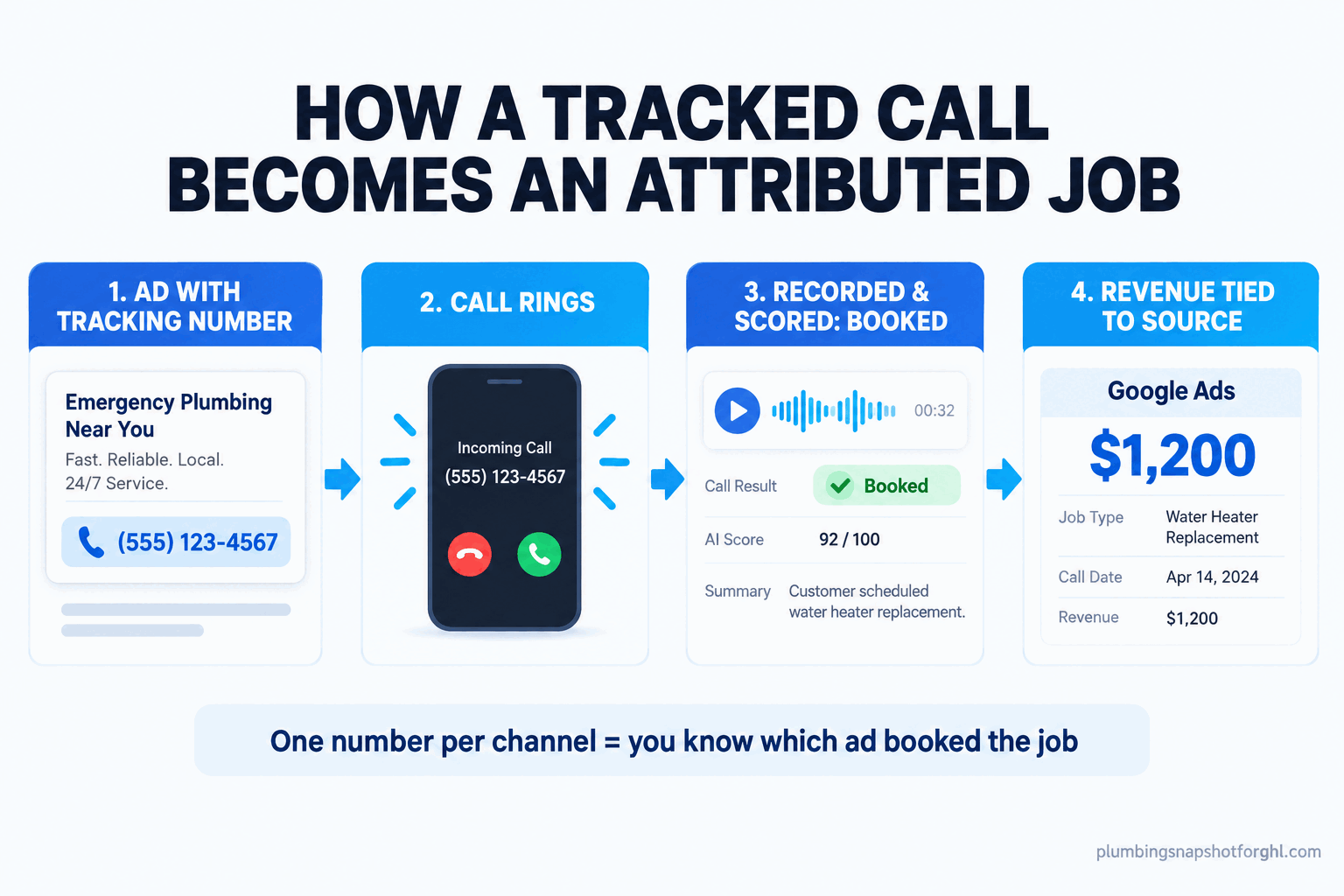
Tracking numbers. A call-tracking tool hands you a pool of numbers that forward to your real line. Put a different one on each channel, and when a call comes in, the tool knows which ad sent that caller.
Dynamic number insertion (DNI). On your website, a snippet of code swaps the displayed number based on how the visitor arrived, so you separate paid traffic from organic even though both land on the same page. The customer never notices.
Recording and tagging. The tool records the call (where the law allows) and lets you mark the outcome: booked, quote, price-shopper, spam. Now each call is a source plus an outcome, and that pairing is the entire value.
Stage 1. A tracking number on every channel
List every way a customer reaches you that costs money, from Google Ads and LSAs to the website, paid social, and the truck wraps. Give each its own tracking number that forwards to your real phone. For the website, use dynamic number insertion so one page still separates paid from organic; for offline spots like the truck, a single static number per source does the job.
How it breaks: you reuse one number across two channels to save a few dollars and blend them permanently, so you never know which one booked. Spend the $3 for the extra number.
Stage 2. Tag the source automatically
A number is only useful if the call lands somewhere you’ll look. Every tracked call should flow into one place, your CRM, with the source already stamped on it: source = Google Ads, source = LSA, source = truck wrap. Nobody should type that by hand, because nobody will on a 7 AM burst-pipe morning. Connecting your call tracking to a system like GoHighLevel handles it, and if you run a speed-to-lead setup, the tracked call is what triggers it.
How it breaks: the source lives in the call-tracking dashboard while your jobs live elsewhere, so month-end becomes a spreadsheet export where you guess which call became which invoice. Stamp the tag on the contact when the call lands.
Stage 3. Record and score the call
Raw call counts lie. A channel that rings 30 times looks great until you find 20 were wrong numbers, robocalls, and people asking if you sell parts. Give every call a simple outcome tag the moment it ends: booked, estimate, existing customer, price-shopper, or junk. Do it by ear, or let a conversation-intelligence feature flag likely bookings. Now you rank channels by booked jobs, not by how often the phone rang.
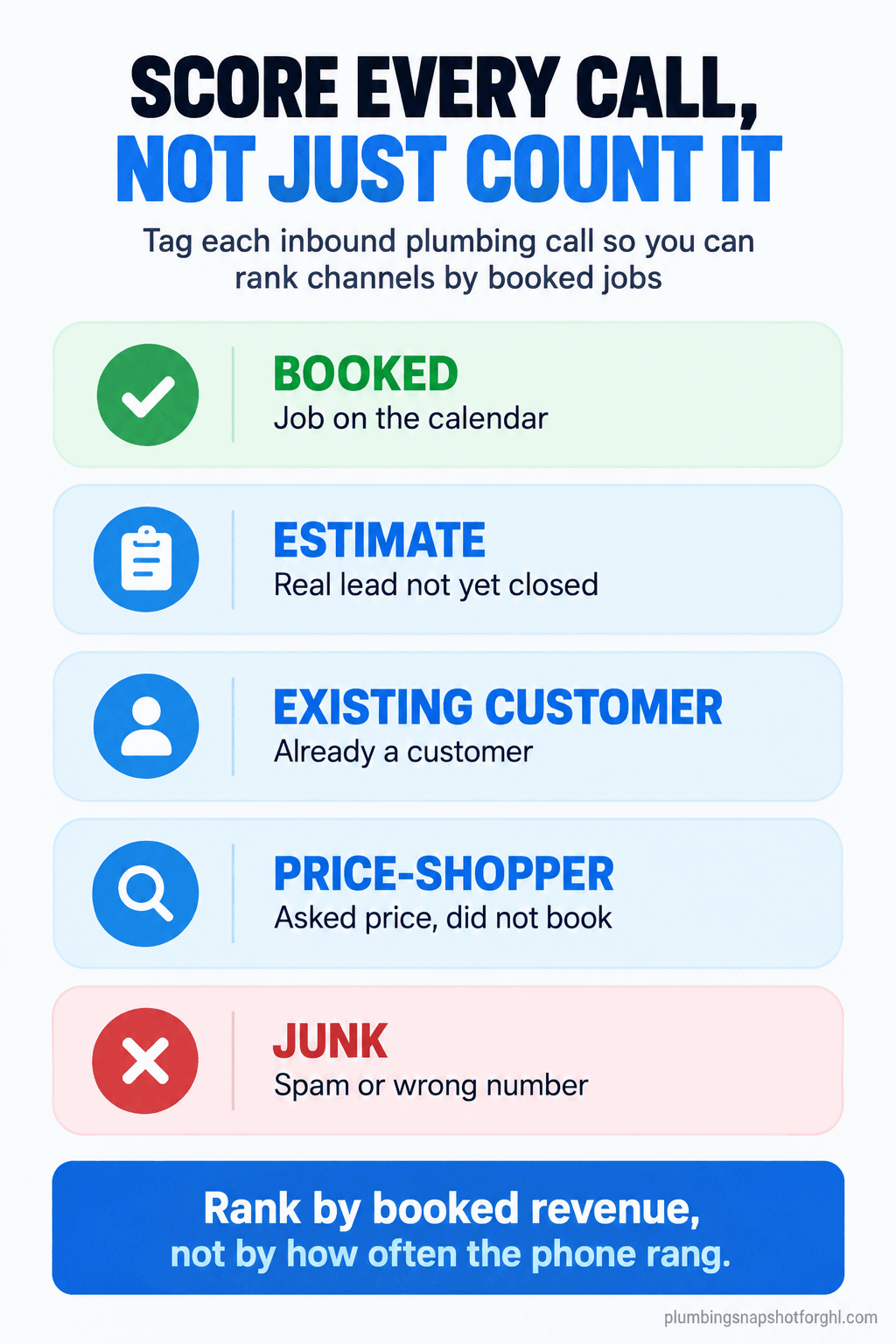
How it breaks: you measure call volume and reward the loudest channel, so the listing that floods you with “how much to snake a drain” calls outranks the campaign quietly booking $6,000 repipes. Score for booked revenue, and the picture flips.
Stage 4. Tie the booked job back to the source
This is the payoff stage most shops skip. You have the source and outcome on each call; now connect the booked call to the job’s dollar value, so you see revenue by channel, not just leads. It’s simple when the data lives in one place: the contact already carries its source tag, so when the job closes, you attach the ticket value. Roll it up and you get the only report that matters. Google Ads cost $800 and booked $9,200. LSAs cost $600 and booked $1,100. The truck wrap cost $150 and booked $4,800. Now the next dollar’s destination is a line on a page, not a feeling, and it’s the backbone of real plumbing marketing KPIs.
How it breaks: you track leads but never revenue, so a channel bringing lots of cheap jobs beats one bringing a few big ones on paper. Attach the job value, and cost-per-booked-dollar tells the truth cost-per-lead hides.
Stage 5. Catch the missed and after-hours calls
Attribution has a blind spot that’s about to get expensive: the calls you don’t answer. A missed call is still a lead, usually an emergency, from a channel you paid for. If your tracking only logs answered calls, you hide the jobs those channels lost.
Two things make this urgent in 2026. Google is changing the rules: Local Services Ads, now moving into Google Ads as pay-per-lead campaigns (Search Engine Journal), will start charging for some unanswered business-hours calls over 20 seconds from October 1, 2026 (PPC Land). Miss the call and you may now pay for it anyway, and after-hours is where your biggest tickets live. So log missed calls with their source, and put something behind them: a missed-call text-back that fires in seconds, or an after-hours answering setup that books while you sleep.
How it breaks: you only read answered-call reports, declare a channel “low volume,” and cut it, when it was sending plenty of calls at 9 PM that rang out. Track the misses, catch them, and the real winner shows up.
Stage 6. Read the report and move the money
None of this matters if you don’t act on it. Once a month, pull one report: by channel, what you spent, how many calls, how many booked, and the revenue. Then do the profitable thing and shift budget from the worst cost-per-booked-dollar channel to the best. You’re after the obvious moves, not perfection: the channel costing $50 per booked job versus the one costing $400, the listing that only sends price-shoppers.
How it breaks: you build the whole system, admire the dashboard, and never change the budget. Data you don’t act on is a prettier version of guessing. Put the 20-minute review on the calendar and treat it like a job.
What the tools cost
Three honest options, depending on your size and what you already run.
Standalone call tracking. CallRail is the best known, at $50, $95, $150, and $195 a month, each including 5 tracking numbers and 250 minutes, with extra numbers at $3 and extra minutes at $0.06 (CallRail pricing). WhatConverts sits in the same range. These are excellent at tracking but don’t book jobs, so you connect them to wherever your work lives.
Built into field software. ServiceTitan and similar platforms include attribution, but pricing is negotiated behind a demo and aimed at bigger shops, so you pay for the whole suite to get it (see what plumbing software actually costs in 2026).
Built into your automation platform. A GoHighLevel setup can provision the numbers, stamp the source, trigger the follow-up, and tie the job value back in one place, solving the Stage 4 problem by default. Here’s how the three compare:
| Approach | Entry cost | Number per channel | Call recording | Source on the job record | Ties revenue back |
|---|---|---|---|---|---|
| CallRail / WhatConverts | ~$50-$195/mo | Yes | Yes | Only if you integrate it | Only if you integrate it |
| Field software (ServiceTitan, etc.) | Demo-only, higher | Yes | Yes | Yes, inside its suite | Yes, inside its suite |
| GoHighLevel automation | Included in the stack | Yes | Yes | Yes, native | Yes, native |
Lead quality also swings hard by channel. Here’s the share of answered calls that are genuine qualified leads:
Percent of answered calls that are qualified leads, by ad channel, across home services (Invoca, 2025).
The compliance you can’t skip
Call tracking records calls, and recording has rules. Most of the country is one-party consent, so you (a party to the call) can record. But roughly a dozen states require every party’s consent, including California, Florida, Illinois, Washington, Pennsylvania, and Massachusetts (Recording Law). The fix is a one-line greeting: “This call may be recorded for quality and training.” The caller staying on the line is their consent. For calls that cross state lines, follow the stricter rule, so use the greeting everywhere.
The other rule touches texting. The moment a tracked missed call triggers an automated text, anything that reads like marketing is in TCPA territory. A plain “sorry we missed you” reply is a different animal from a promotional blast, but the safe habit is to collect consent to text at booking and keep automated messages about the job. Our TCPA guide for plumbers covers the consent language and 10DLC registration; the FCC’s telemarketing rules are the federal source.
Solo, 5-truck, and 15-truck
The system is identical at every size. What changes is how much you automate.
Solo owner-operator. You’re the one answering, so keep it dead simple. Two or three numbers: paid Google or LSA, the website, the truck and signs. Score calls by ear each evening with a five-word note. You don’t need revenue roll-ups yet, just whether the $600 you spend is ringing at all. Most solo shops find one channel is carrying the other two.
Five-truck shop. Now a dead channel costs real payroll. Put a number on every channel, get the source onto the contact automatically, and attach job values so you can rank by booked revenue. The leak at your size is usually a source that looks busy but only sends price-shoppers, and scoring exposes it.
Ten-to-fifteen trucks. Here the problem is volume you can’t eyeball. Hundreds of calls across six channels means you need conversation intelligence flagging bookings, missed-call tracking feeding a catch system, and a dashboard showing cost-per-booked-dollar by channel. The gap between your best and worst channel at this size is tens of thousands a year.
Steal this: the setup scripts
Copy these, adjust, use them.
The source-tag list (use the same names everywhere):
google-adsfor paid search,lsafor Local Services Ads,gbpfor the Google map pack,website-organicfor people who found you and typed your name,truck-signsfor wraps and yard signs,direct-mailfor postcards,referralfor word of mouth.
Identical names in your CRM and your ad reports make month-end matching take minutes.
The recording greeting (set once per tracking number):
“Thanks for calling [shop name]. This call may be recorded for quality and training. How can we help?”
It satisfies all-party consent states and doubles as a professional open.
The call-scoring tags (one per call, every call):
booked·estimate·existing-customer·price-shopper·junk
Five tags, no more, so anyone who answers phones can tag a call in two seconds.
The monthly “move the money” review (20 minutes):
- Pull spend, calls, booked jobs, and booked revenue by channel.
- Calculate cost per booked job for each.
- Find the best and worst channel on that number.
- Shift one chunk of budget from worst to best.
- Note the change and the date. Compare next month.
Objections, answered straight
“I already ask every caller how they found us. Isn’t that enough?” No, and not because your front desk is bad. Customers genuinely don’t know. They saw your truck, searched your name a week later, then clicked an ad, and remember only the last step. A tracking number records what actually happened, not what the customer half-remembers.
“This sounds like a lot of tech for a plumbing shop.” The hard part is one code snippet and a handful of numbers, an afternoon’s work once. After that it runs itself: calls come in pre-tagged, you score each in two seconds, and you read one report a month. A done-for-you setup wires it so you only ever see the report.
“My gut has been fine.” Gut can’t tell you the LSA spend you’re proud of books at $400 a job while the truck wrap you forget about books at $30. Those findings pay for the system in a month, and they’re invisible until you measure. Run it for 60 days and let the numbers argue.
Frequently asked questions
What is call tracking for a plumbing business?
Call tracking gives each marketing channel its own phone number that forwards to your real line, so when a call comes in, the system already knows which ad or listing the customer dialed from. Paired with call recording and outcome scoring, it tells you not just how many calls a channel sent, but how many actually booked a job.
How do I know which plumbing ads are actually working?
Put a unique tracking number on every channel (Google Ads, Local Services Ads, your website, Facebook, the truck wraps), score each call as booked or not, and attach the job's value to the booked ones. Then compare cost against booked revenue by channel. The ad that rings and books gets more budget; the one that's quiet or only sends price-shoppers gets cut.
Is it legal to record customer calls as a plumber?
In most states, yes, because they are one-party consent and you are a party to the call. But roughly a dozen states, including California, Florida, Illinois, Washington, Pennsylvania, and Massachusetts, require every party to consent. A greeting, 'this call may be recorded for quality and training,' satisfies those states; the caller staying on the line is their consent. When in doubt, use it on every number.
Will Google really charge me for calls I miss?
For Local Services Ads, yes, starting October 1, 2026. Google is beginning to bill for some unanswered calls placed during business hours that last longer than 20 seconds, as those ads move into Google Ads as pay-per-lead campaigns. A missed call can now cost you both the job and the lead fee, so answering or instantly catching every call matters even more.
Do I need separate software, or can my CRM do call tracking?
Both work. Standalone tools like CallRail (around $50 to $195 a month) are excellent at tracking but don't book your jobs, so you connect them to wherever your work lives. An automation platform like GoHighLevel can provision the numbers, tag the source onto the contact, and tie revenue back in one place, removing the integration step. The right choice depends on what you already run.
How many tracking numbers does a small plumbing shop need?
A solo operator usually starts with two or three: one for paid ads, one for the website, and one for offline (truck and signs). A multi-truck shop wants one per channel, so around six to eight, so no two sources share a line. Extra numbers typically cost a few dollars each per month, trivial next to the attribution they buy.
Tyler owns the TCPA, consent, and conversion guidance in the Plumbing Snapshot, and he spends his days making sure the automated calls and texts that book plumbing jobs stay both legal and effective. Related reading: missed-call text-back for plumbers, Google Local Services Ads for plumbers, and how to get more plumbing leads in 2026.